The global demand for forest and field-grown berries is reshaping rural economies, creating new opportunities for producers and traders while raising complex questions about resource management, supply chains, and market positioning. This article examines the current state of the wild berry sector, explores production and processing pathways, and assesses the export potential of wild and semi-wild berries. Throughout, attention is given to strategies that can enhance competitiveness, improve livelihoods for smallholders and harvesters, and ensure long-term sustainability of natural resources.
Market dynamics and global demand patterns
Wild and semi-cultivated berries—such as bilberries, lingonberries, cloudberries, cranberries, and various wild raspberries and blackberries—occupy a specialist niche that has expanded into mainstream markets over the past two decades. Consumer interest in natural, nutrient-dense foods has raised the profile of berries as ingredients in functional foods, dietary supplements, beverages, cosmetic formulations, and gourmet products. Retailers and processors increasingly look for suppliers who can offer consistent volumes, documented quality, and trusted provenance.
Key market drivers
- Health and nutrition trends: Antioxidant content, perceived health benefits, and “clean label” preferences drive demand for berry-derived ingredients and finished products.
- Premiumization: Consumers are willing to pay a premium for exotic or seasonal varieties, sustainably harvested products, and products with authenticated origin stories.
- Ingredient diversification: Food manufacturers and cosmetic brands use berry extracts and powders to diversify textures, flavors, and functional claims.
- E-commerce and specialty retail growth: Digital channels and specialty stores expand reach for niche berry products, enabling small producers to access distant markets.
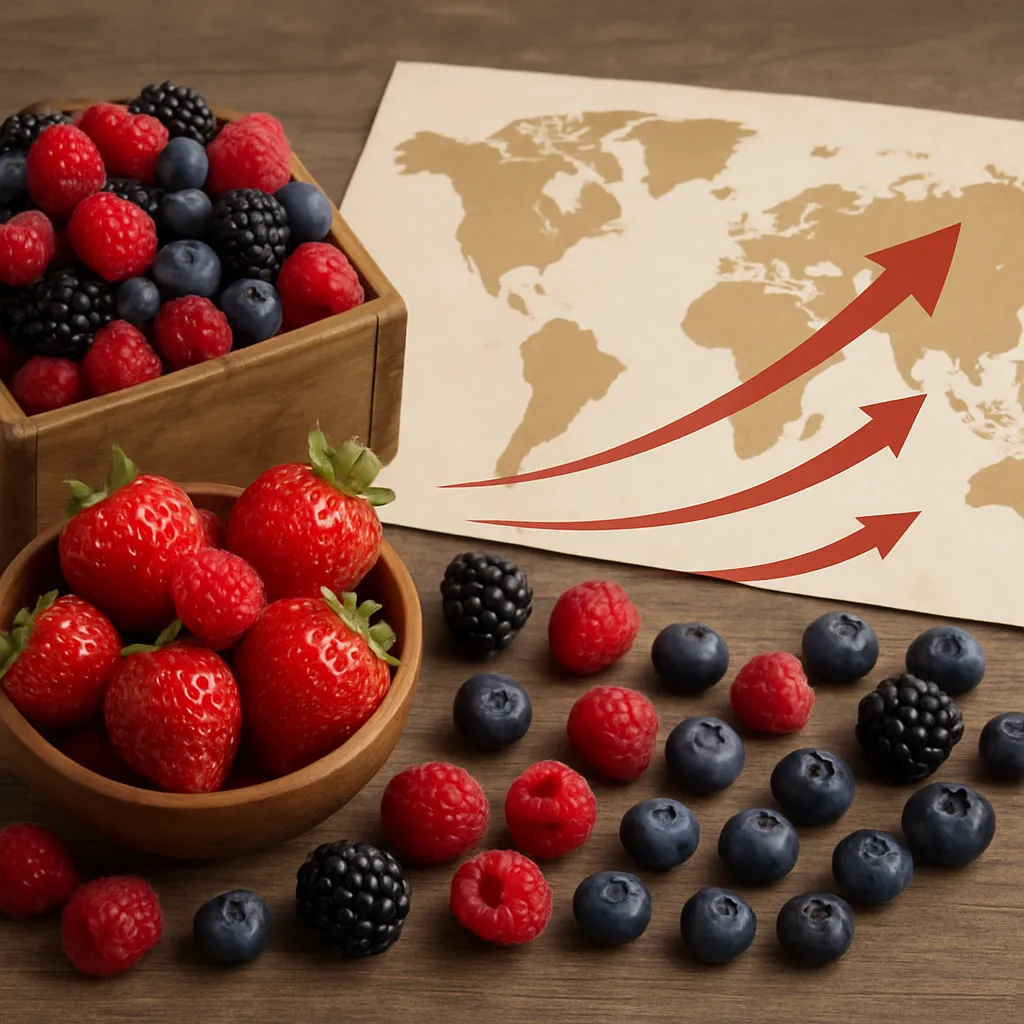
Major import markets include the European Union (for intra-continental trade), the United States, Japan, and increasingly China and South Korea for premium functional ingredients. Trade flows vary by species and product form: fresh and frozen berries tend to flow to proximate markets due to perishability, while dried, powdered, and extract forms are easily traded internationally because of longer shelf life and lighter logistics footprints.
Production systems, resource management and community roles
Wild berries are produced across a spectrum: entirely wild-harvested from natural stands, semi-wild gathered from managed forests, or cultivated in fields and plantations. Each system has implications for yield predictability, ecological impact, and the participation of local communities. Many rural and indigenous households rely on berry harvesting for supplemental income, nutritional diversity, and cultural practices, making the sector both economically and socially significant.
Harvesting methods and best practices
- Selective handpicking remains the standard for high-value berries intended for fresh markets or premium processing.
- Mechanized harvesting can increase throughput for certain species but risks damage to plants and to berry quality if not carefully managed.
- Forest stewardship: Rotational harvesting, stewardship agreements, and community-managed quotas help maintain wild stands and biodiversity.
Improving the capacity of harvesters—through training in sustainable collection, post-harvest handling, and basic quality control—directly improves quality and marketability. Establishing local cooperatives or aggregation centers can reduce transaction costs and improve bargaining power for small-scale collectors, while enabling investments in cold storage and preliminary processing.
Processing, value addition and product diversification
Processing transforms perishable raw berries into higher-value products that open export channels and lengthen sales windows. Key value-added products include frozen fruit, IQF (individually quick frozen) berries, juices, purees, concentrates, freeze-dried powders, extracts (including anthocyanin-rich fractions), and cosmetic-grade oils and serums.
Technologies and approaches
- Freezing and IQF: Vital for preserving flavor and nutritional value for export to distant markets.
- Freeze-drying: Yields lightweight, nutrient-dense powders attractive to the nutraceutical and gourmet markets.
- Cold-pressed juices and concentrates: Require investment in hygienic processing and pasteurization to meet food safety standards.
- Extraction for nutraceuticals and cosmetics: Sophisticated solvent, supercritical CO2, or enzymatic processes can target high-value compounds.
Investments in processing infrastructure can unlock higher price points and reduce post-harvest losses. Contract manufacturing, mobile processing units, and shared-use facilities are pragmatic models for regions where production remains geographically dispersed or seasonal.
Trade, certification and market access
Export success depends on meeting buyer specifications and regulatory requirements. For many markets, documented traceability, compliance with maximum residue levels (MRLs), sanitary and phytosanitary (SPS) norms, and product standards are non-negotiable. Certifications—such as organic, Fair Trade, or sustainability labels—can open premium niches but also require investments in record-keeping, audits, and often changes to management practices.
Market entry strategies
- Targeted segmentation: Focus on premium niche markets (organic, wild-harvested) or commodity markets (frozen berries for processing) depending on scale and quality.
- Private labeling and co-packing: Partnering with established brands reduces market development costs for producers.
- Geographic specialization: Exploiting off-season production windows or unique varieties for niche demand (e.g., cloudberries for Scandinavian gourmet markets).
Logistics is a critical determinant. Fresh and frozen exports require efficient cold chains and rapid border clearance, while dried and extract products are more forgiving. Public-private collaboration to improve transport links, cold storage hubs, and customs facilitation can substantially reduce time-to-market and spoilage rates.
Challenges, risks and mitigation measures
Several constraints hamper the sector’s expansion: variability in annual yields due to climate and ecological factors, fragmented supply bases, limited processing capacity, and gaps in market intelligence. Overexploitation of wild stands, unclear land-use rights, and weak benefit-sharing mechanisms can provoke social conflicts and environmental degradation.
Risk management and resilience-building
- Diversification: Encouraging mixed production systems (wild harvesting plus small-scale cultivation) reduces dependence on a single income stream and stabilizes supply.
- Quality assurance programs: Training and simple grading protocols help match supply to different market tiers.
- Seasonal storage and processing: Extending the selling season through processing reduces price volatility.
- Climate adaptation: Research into resilient varieties and forest management practices can mitigate yield fluctuations.
Access to finance is another barrier. Smallholder harvesters and processors often lack collateral for bank loans; blended finance models, microcredit, and targeted grants for certification or equipment can catalyze upgrades in processing and compliance.
Policy, governance and investment priorities
Strategic public policies and targeted investments can amplify the export potential of wild berries while protecting ecological and social values. Priority actions include:
- Support for small-scale processing: Grants or low-interest loans for building community freezers, drying facilities, and cold-chain infrastructure.
- Capacity building: Extension services to teach sustainable harvesting, post-harvest handling, food safety, and business skills.
- Standards and certification assistance: Subsidized audit costs and technical support to achieve organic or sustainability certifications.
- Data collection and market intelligence: Publicly available trade data, price monitoring, and market forecasts help producers make informed decisions.
- Secure land and harvesting rights: Legal frameworks that recognize community rights and establish benefit-sharing mechanisms protect livelihoods and resources.
Publicly led promotion campaigns and participation in trade fairs can increase visibility for origin-branded products. Investment in R&D—particularly on value-chain optimization, improved processing methods, and shelf-life enhancement—yields long-term returns by increasing product competitiveness.
Business models and strategies for scaling exports
Several practical models have shown promise in scaling wild berry exports while preserving local benefits. Cooperative aggregation models improve bargaining power and enable collective investments in processing. Contract farming and buyer-led aggregation offer market certainty to producers and steady supply to buyers. Social enterprises that reinvest profits into community development can balance commercial and social objectives.
Examples of value-adding approaches
- Premium branded goods: Position origin-labeled, sustainably harvested berries in gourmet and health-conscious markets.
- Ingredient suppliers: Processors supply standardized extracts and powders to nutraceutical, beverage, and cosmetics industries.
- Private label partnerships: Collaborate with retailers and food producers to supply finished goods under their brands.
Marketing stories that highlight provenance, traditional harvesting methods, and community benefits resonate with niche consumers. Combining such narratives with verifiable certification improves credibility and price realization.
Opportunities for sustainable growth
The intersection of growing global demand for natural ingredients, the uniqueness of many wild berry species, and the potential for rural income generation creates a strong case for investment. By prioritizing value chains that protect ecosystems and reward local stakeholders, stakeholders can expand exports without sacrificing the natural capital that underpins the sector.
- Integration with tourism and gastronomy: Agritourism and culinary festivals can raise profile and create direct sales channels.
- Innovation in packaging and shelf-life: Modified atmosphere packaging and small-format premium packaging can open retail shelves in urban and export markets.
- Collaborative platforms: Digital marketplaces and traceability platforms link producers to buyers and reduce information asymmetries.
Investing in human capital—training pickers, processors, and managers—builds the institutional capacity necessary to meet stringent export standards. Supporting equitable value distribution ensures that the benefits of increased trade flow to the families and communities that steward wild berry landscapes.
Conclusion
Wild berry markets present a compelling combination of ecological, economic, and cultural value. Expanding export potential requires coordinated action across production, processing, certification, logistics, and marketing. Prioritizing farmers and harvesters, enforcing clear governance around harvesting rights, and investing in targeted infrastructure and capacity building set the stage for resilient and profitable trade. With thoughtful policies and private sector engagement, wild berry sectors can grow into sustainable export earners while preserving the natural ecosystems and community livelihoods that make them unique.