The global poultry meat sector occupies a central role in modern agriculture, linking primary production, processing industries, and international markets. Changes in consumer preferences, animal health challenges, and shifting trade policies have reconfigured supply chains and competitive advantages. This article explores the major forces shaping trade flows in poultry meat, examines the strategies of leading exporters and importers, and considers the implications for producers, policymakers, and downstream actors in the value chain.
Market dynamics and structural drivers
Poultry stands out among animal proteins for its relative cost-efficiency, rapid production cycles, and adaptability to different farming systems. These attributes have propelled global consumption upward, especially in emerging economies where rising incomes drive dietary changes. Key structural drivers include feed prices, technology adoption, and demographic trends. The following factors are central:
- Feed and input costs: Corn and soybean meal prices directly affect production margins and the competitiveness of exporting countries.
- Productivity gains: Genetic selection, improved nutrition, and precision farming reduce unit costs and expand supply.
- Consumption patterns: Urbanization and changing lifestyles increase demand for processed and convenient poultry products.
- Regulatory frameworks: Sanitary standards and import regulations shape market access and trade flows.
- Biosecurity and animal health: Outbreaks of avian influenza or other diseases can quickly disrupt exports and domestic supply.
These drivers interact with international logistics and trade policy to determine which countries become net exporters or importers. For instance, nations with cheap feed and vertically integrated producers tend to dominate export markets, while high-income consumers may import specific cuts or highly processed products.
Trade flows: major exporters, importers, and routes
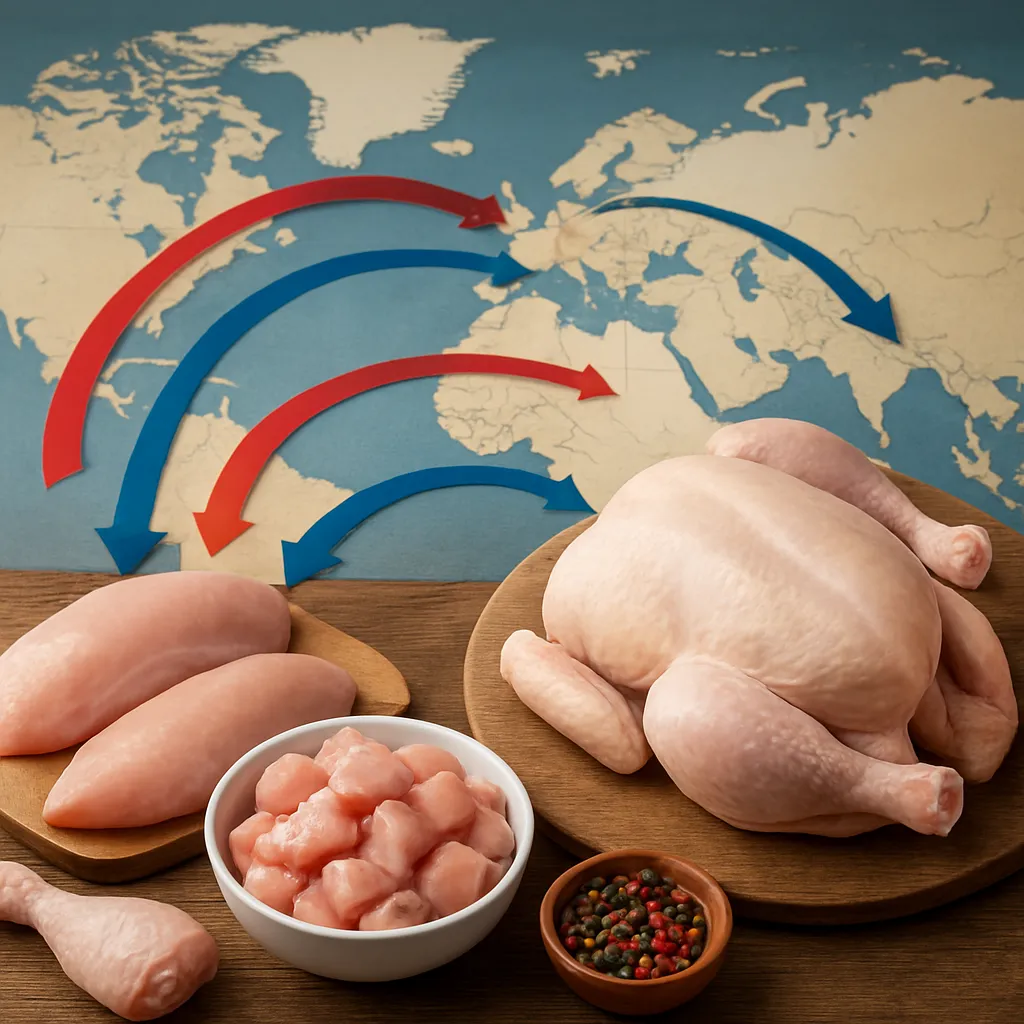
Global poultry trade is characterized by a small number of dominant exporters and a geographically diverse set of importers. Major exporting countries rely on scale, integration, and market access to maintain their positions. Typical patterns include:
- Brazil, the United States, and the European Union as consistent large-volume exporters of both fresh and frozen poultry.
- Middle Eastern and North African countries, along with several East Asian economies, serve as important import markets due to limited domestic production or high demand for specific quality segments.
- Intra-regional trade in Africa, Latin America, and Southeast Asia that supplies nearby markets and reflects regional production strengths.
Leading exporters and their competitive advantages
- Brazil: Benefits from integrated feed-poultry complexes, low labor costs relative to developed economies, and extensive processing capacity geared toward exports.
- United States: Strong emphasis on productivity, specialized cuts, and processed items; robust logistics networks and established market relationships.
- European Union: High standards for food safety and traceability, niche exports in premium or value-added products, and regulatory-driven product segmentation.
Main import markets and demand characteristics
- China: Large and diverse demand, sensitive to price and safety; import patterns shift rapidly with domestic production changes and animal disease events.
- Middle East: Preference for halal-certified products and steady import demand for frozen portions and whole birds.
- Africa: Growing import dependence in certain countries where local production cannot keep pace with population growth.
Competition, policy, and market access
Competition in global poultry markets is not only about production costs. Trade policies, sanitary rules, and corporate strategies shape outcomes. Tariffs, non-tariff measures, and bilateral agreements determine how easily exporters can enter markets. Key aspects include:
- Tariffs and preferential trade agreements that open or restrict access for certain suppliers.
- Sanitary and phytosanitary (SPS) measures used legitimately to protect public and animal health, but sometimes applied in ways that act as trade barriers.
- Certification demands—such as halal, organic, or animal welfare labels—that create segmented markets and premium niches.
- Anti-dumping and safeguard investigations that can temporarily shield domestic producers from surges in low-priced imports.
Large processors and multinational firms often secure long-term contracts with retailers and foodservice chains, leveraging scale to influence prices and logistics. Vertical integration—from feed mills to slaughterhouses and cold storage—confers resilience and cost advantages, particularly for exporter countries aiming to meet stringent foreign standards.
Supply chain resilience, biosecurity, and disease management
Poultry systems are highly vulnerable to infectious disease outbreaks. Avian influenza, Newcastle disease, and other pathogens can decimate flocks and close export markets overnight. Building resilience requires investments across the chain:
- Farm-level measures: vaccination programs, controlled housing, and training to reduce disease risk and improve early detection.
- Traceability systems: digital tracking of batches and movements to facilitate rapid containment and reassure importing countries.
- Cold chain and logistics upgrades: ensuring product quality and compliance with temperature-sensitive standards through transportation and storage improvements.
- Emergency response coordination: clear protocols between public authorities and the private sector to minimize trade disruptions.
Successful disease management supports both domestic food security and international credibility. Exporters that maintain transparent surveillance and rapid reporting frameworks are more likely to retain market share during regional health challenges.
Sustainability, environmental pressures, and consumer expectations
Environmental concerns and consumer preferences are increasingly reshaping poultry markets. Producers face pressure to reduce greenhouse gas emissions, manage nutrient runoff, and improve animal welfare. Evolving expectations translate into market signals:
- Retailers and foodservice firms demanding evidence of sustainable sourcing and reduced environmental footprint from suppliers.
- Certification schemes and lifecycle assessments that quantify impacts and create opportunities for product differentiation.
- Investment in alternative proteins and plant-based substitutes that influence long-term demand trajectories for animal-sourced proteins.
Producers and exporters who adopt more efficient feed formulations, better manure management, and renewable energy solutions can lower costs and meet rising buyer expectations. Sustainability also intersects with trade: some importing countries may impose carbon-related measures or prefer suppliers demonstrating low-impact production.
Innovation, technology, and future competitiveness
Technological innovation shapes the competitive landscape in tangible ways. Automation in processing, precision nutrition, and data-driven flock management increase yields and reduce labor dependencies. Digital platforms streamline trading and compliance documentation, facilitating faster market access. Notable trends include:
- Precision farming tools that optimize feed conversion ratios and reduce waste.
- Supply chain digitization enabling real-time monitoring of shipments and automated certification for customs clearance.
- Genetic improvements aimed at resilience and efficiency rather than solely growth rate, aligning with welfare and sustainability goals.
These innovations favor producers who invest in human capital and infrastructure. Access to finance and public-private partnerships can accelerate technology diffusion in developing country producers, narrowing some competitive gaps with established exporters.
Implications for stakeholders and strategic priorities
For policymakers, business leaders, and farmers, the poultry trade environment suggests several strategic priorities. Strengthening safety nets for smallholders, enhancing export readiness through quality assurance, and negotiating pragmatic trade rules can expand opportunities. Important actions include:
- Investing in veterinary services and disease surveillance to protect both domestic supplies and export reputation.
- Supporting infrastructure—ports, cold storage, and roads—to reduce post-harvest losses and ensure timely deliveries.
- Encouraging value-added processing to capture a larger share of export revenues and to meet diverse market demands.
- Facilitating access to finance and extension services so smaller producers can adopt productivity-enhancing technologies.
Competitiveness in the global poultry market will increasingly depend on the ability to combine cost efficiency with high standards of health, environmental performance, and product differentiation. Countries and firms that align production practices with shifting buyer expectations will be better positioned to compete in both established and emerging markets.