The global market for fresh produce is undergoing rapid transformation as growers, buyers, and policymakers confront the twin pressures of shrinking rural workforces and rising demand for high-quality, year-round supply. Nowhere are these forces more visible than in the niche yet economically significant sector of asparagus production. This article explores agricultural markets, the labor realities behind field-to-fork supply chains, and the evolving role of robotics and automation in addressing persistent challenges faced by producers and communities.
Market dynamics and the economics of asparagus
Asparagus is a specialty crop with a concentrated season, high labor requirements, and strong consumer preference for freshly harvested spears. Market prices fluctuate with seasonality, weather, and the availability of skilled pickers. In many importing countries, year-round supply is achieved through global sourcing: spring from Europe, winter from parts of South America, and out-of-season production in controlled environments. This global choreography creates both opportunities and vulnerabilities for farmers.
Buyers are increasingly sensitive to consistency, traceability, and environmental credentials. Retailers and food service operators reward predictable supply and invest in supplier relationships that can deliver certification, lower waste, and better shelf life. Such market demands drive producers to consider investments in technology that enhance yield predictability and post-harvest handling. At the same time, producers must weigh capital costs against thin margins typical of many fresh produce segments.
- Price volatility: short harvest windows amplify the impact of yield swings on farm income.
- Quality premiums: consistently tender, unblemished spears command higher prices.
- Supply chain length: closer production-to-market proximity reduces logistics risk and increases freshness.
- Regulatory pressures: labor laws, food safety, and sustainability reporting add to operational complexity.
Labor shortages, seasonal migration, and social impacts
The most immediate challenge for asparagus producers is access to reliable labor. Harvesting asparagus is time-sensitive and relatively skilled work: pickers must select spears at the correct height, cut without damaging crowns, and work at pace across acres. Many regions face long-term declines in agricultural labor availability as rural populations age and alternative employment draws younger workers to urban centers.
Seasonal migration has historically filled gaps—workers traveling across borders or regions for harvest peaks. However, migration policies, travel disruptions, and changing worker preferences have reduced the predictability of that labor pool. Employers report higher turnover, difficulties in recruiting during peak weeks, and increasing competition from other sectors offering better hours or higher nominal wages. The result is a rise in harvesting costs and, in some cases, lost or delayed harvests that reduce quality and yield.
There are notable social considerations when labor is scarce or precarious. Fair wages, working conditions, and access to social services for agricultural workers are ethical imperatives and market differentiators. Consumers and buyers are paying more attention to provenance claims that include labor practices. Improving the attractiveness of agricultural work—through better housing, transport, and mechanization that complements rather than replaces human roles—can help stabilize rural livelihoods.
Robotics and mechanized harvesting: technologies and trade-offs
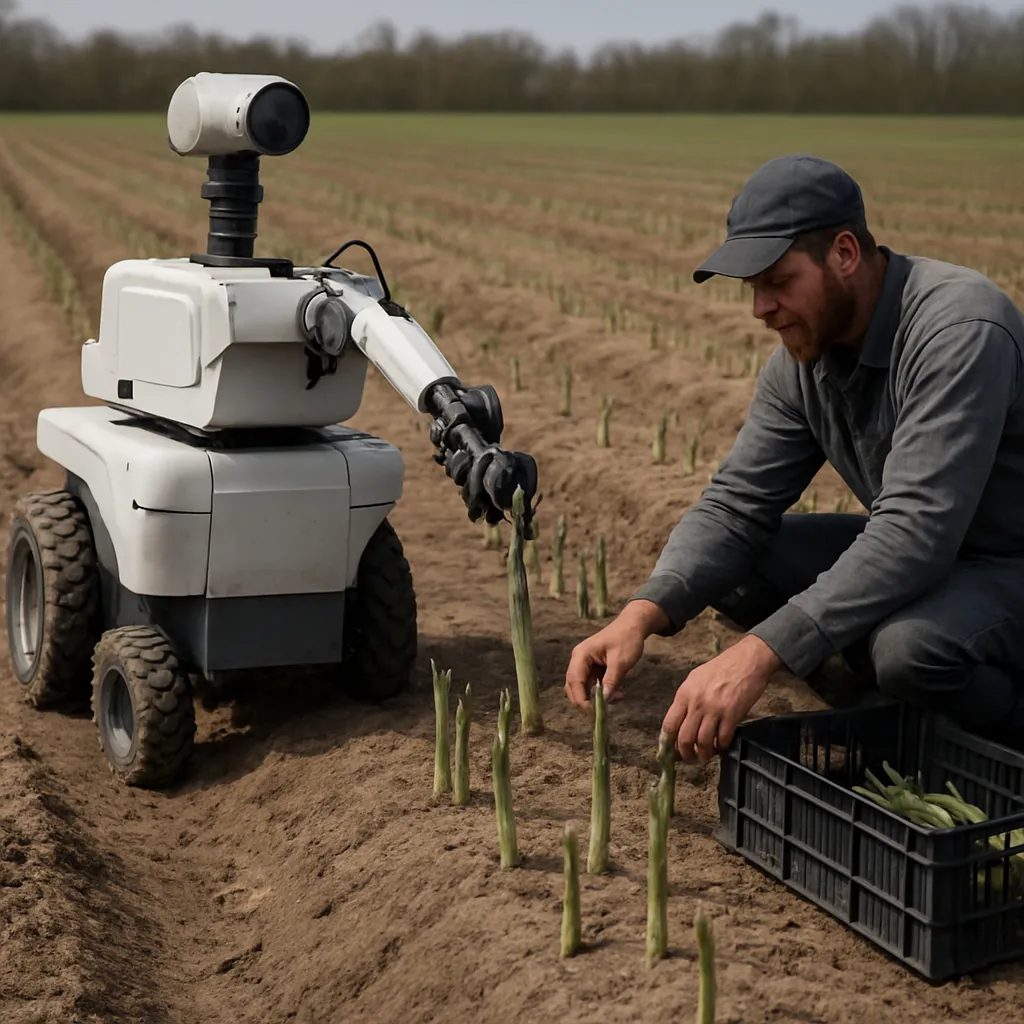
Advances in sensing, machine vision, and mobile robotics have opened new possibilities for mechanizing tasks once considered too delicate or variable for machines. In asparagus fields, autonomous and semi-autonomous systems are being developed to identify spear emergence, position cutting tools precisely, and transport harvested product efficiently. These technologies promise gains in efficiency, reduced labor dependency, and even improved ergonomics for remaining workers.
Several technical approaches are being tested and commercialized:
- Vision-guided arms: robots using cameras and AI to distinguish spears from foliage and soil, targeting cuts with millimeter precision.
- End-effector knives and vacuum handling: tools designed to cut without bruising and gently place spears into bins or conveyors.
- Autonomous platforms: mobile bases that traverse rows, carry tools and containers, and coordinate with on-field workers or central systems.
- Hybrid systems: machines that handle bulk movement and primary cutting while human operators perform quality sorting and delicate tasks.
However, adoption is not without trade-offs. Upfront capital for research, prototypes, and commercial machines can be substantial. Many family farms and cooperatives operate with limited borrowing capacity, making lease or service models more attractive than outright purchase. Integration with existing field practices—row spacing, planting geometry, and weed management—may require changes to agronomy that carry transition costs. Additionally, machines must cope with variability in soil, weather, and cultivar differences that complicate reliable automated detection.
Operational models and business cases
To justify investment, producers and technology providers are exploring several business models:
- Contract harvesting services: third-party providers operate fleets of harvest robots, offering pay-per-use models that reduce capital barriers for growers.
- Cooperative ownership: farmer cooperatives pool resources to buy or lease robotic equipment, sharing operational time and maintenance costs.
- Incremental automation: phased adoption where machines handle the bulk of repetitive cutting while human crews focus on sorting, packing, and quality control.
- Data-as-a-service: machines collect agronomic and harvest data sold back to growers or aggregated for market intelligence, creating additional revenue streams.
Economic assessments should include not only direct labor savings but also reductions in waste, improved harvest timing, and possible premiums from traceability and reduced chemical use. For some producers, especially those with large, uniform plantings, the payback period can be attractive. For others with small plots or highly variable fields, the calculus favors shared ownership or waiting for lower-cost technologies.
Environmental and sustainability implications
Mechanization can contribute to more sustainable asparagus production when implemented thoughtfully. Precise cutting reduces damage to crowns and can improve plant longevity, thereby reducing replanting needs and associated resource use. Robots equipped with sensors can monitor pest and disease pressure, enabling targeted interventions and reduced pesticide applications. In addition, better-timed harvests minimize post-harvest losses and lower greenhouse gas emissions per kilogram of marketable product by improving supply chain efficiency.
That said, the environmental footprint of manufacturing, transporting, and powering robotic systems must be considered. Electrification of platforms and integration with renewable energy at farm level can mitigate emissions. Lifecycle assessments help stakeholders understand trade-offs and design technologies and business models that align with sustainability goals.
Policy, training, and the human dimension
Public policy plays a pivotal role in shaping how quickly and equitably these technologies diffuse. Subsidies or tax incentives for capital investment, support for cooperative models, and funding for research can accelerate adoption. Equally important are programs that focus on workforce development: training workers to operate, maintain, and collaborate with robotic systems creates higher-skilled rural employment opportunities and preserves social cohesion.
Training initiatives can include:
- Technical certification for machine operation and maintenance.
- Short courses on data management and interpretation for yield optimization.
- Extension services to help farmers redesign fields and workflows for robotic compatibility.
When policy and industry work together, it is possible to design transition pathways that protect vulnerable workers, redistribute gains across value chains, and promote inclusive innovation. Examples include wage support during transition, investment in rural broadband to support connected machinery, and standards for fair labor practices linked to procurement preferences.
Future outlook: convergence of technologies and market signals
Overall, the intersection of market demand, labor constraints, and rapid technological progress suggests that asparagus production will increasingly rely on a mix of human and robotic labor. Innovation in sensors, AI, and energy systems will continue to lower costs and improve reliability, while evolving market premiums for sustainability and traceability will reward early adopters who can deliver consistent, high-quality product at scale.
Key trends to watch include the maturation of service-based robotic models, improved interoperability between machines and farm management software, and regulatory frameworks that balance efficiency gains with social protections. For growers, the strategic challenge is to assess their operational scale, financial capacity, and long-term market position to determine the right blend of mechanization and human expertise.
Ultimately, successful transitions will depend on collaboration among farmers, technology providers, policymakers, and buyers. When deployed thoughtfully, robotics can help secure the future of specialty crops like asparagus, preserving livelihoods, enhancing efficiency, and supporting more sustainable supply chains while addressing the persistent challenge of reliable workers and rising labor costs.