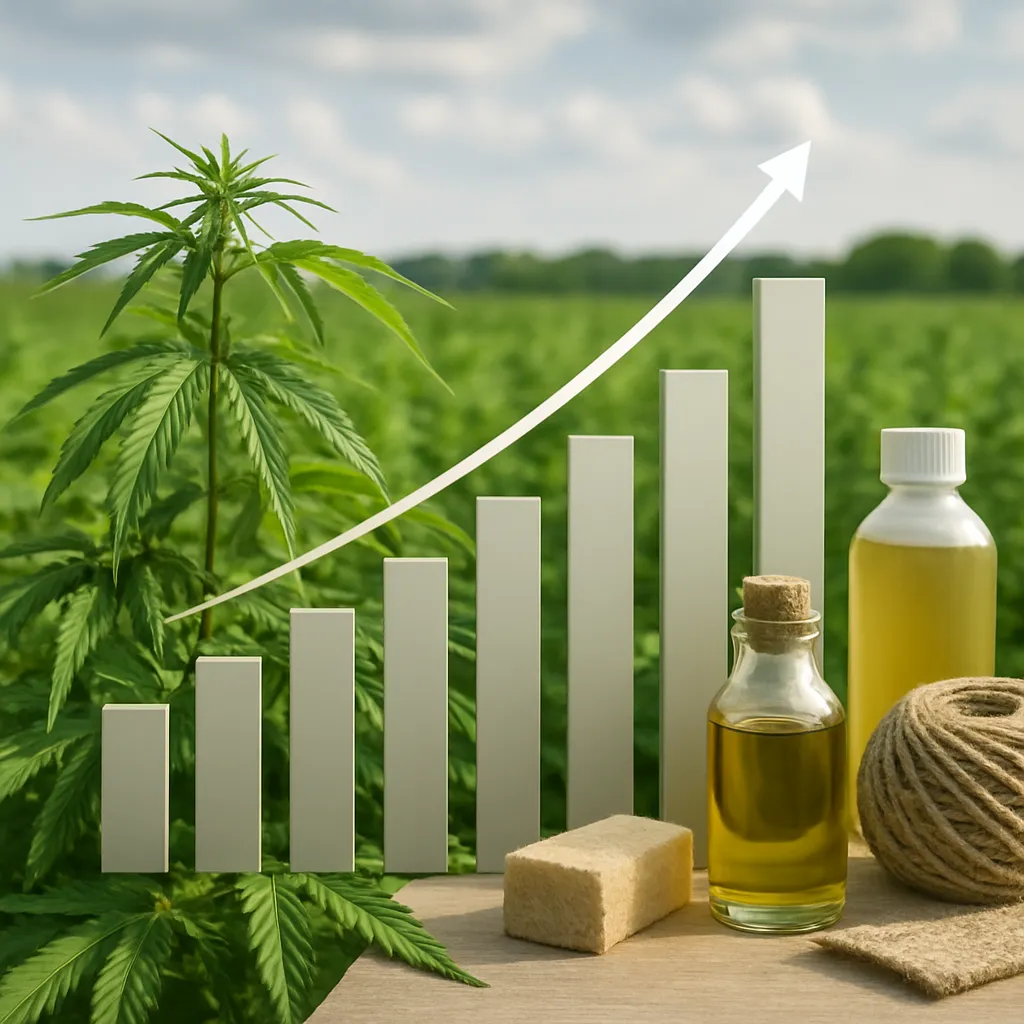
The revival of industrial crops has reshaped agricultural markets worldwide, with hemp emerging as a versatile contender across food, fiber, and industrial applications. This article examines the current trajectory of the industrial hemp sector, its integration into contemporary farming systems, and the most promising avenues for future application. Attention to supply chains, regulatory frameworks, and environmental benefits will help farmers, processors, and investors understand where opportunities and risks align.
Market Dynamics and Growth Drivers
The global demand for hemp-based products has expanded rapidly over the past decade, driven by consumer interest in natural materials and innovations in processing. Firms across textiles, construction, and personal care are adopting hemp-derived inputs, supported by increased public acceptance and evolving regulations. Key contributors to this momentum include rising consumer awareness of sustainability, improvements in extraction technologies for cannabinoid products, and investments into processing infrastructure that reduce production costs.
Market segmentation shows clear growth pockets. Traditional markets for fiber and seeds coexist with newer, high-margin niches such as CBD and specialty nutraceuticals. Meanwhile, industrial actors are pursuing large-scale uses of hemp hurds and bast in composites and biomaterials. Institutional buyers—particularly in the construction and automotive sectors—are piloting hemp-based components that promise lightweight, insulating, and low-carbon solutions.
- Consumer goods: textiles, cosmetics, and foods using hemp-derived ingredients.
- Industrial applications: bioplastics, panels, and composite materials substituting petrochemical inputs.
- Health and wellness: cannabinoid extracts, functional foods, and supplements.
Agronomic Practices and Farming Considerations
Successful hemp integration into farm rotations relies on understanding crop physiology and local market access. Hemp is valued for its rapid biomass accumulation, efficient nutrient use, and capacity to provide both seed and fiber yields. Farmers considering hemp must evaluate soil conditions, seed variety selection, and processing proximity to minimize transport costs and preserve quality.
Hemp can enhance farm-level resilience through improved crop rotation benefits, breaking pest and disease cycles while potentially improving soil structure. However, there are agronomic challenges: uniform seedbed preparation, weed management in early growth stages, and matching cultivar characteristics to intended end-use (grain vs. fiber vs. dual-purpose). Adoption of mechanization for planting, harvesting, and retting (for fiber separation) is pivotal to scale production efficiently.
Best practices for cultivation
- Choose cultivars aligned with market requirements—fiber varieties differ significantly from high-seed or cannabinoid cultivars.
- Soil testing and nutrient management plans to optimize yield without excess fertilizer inputs.
- Integrated pest management focused on prevention, biological controls, and targeted treatments to maintain product quality.
- Establish local processing partnerships or cooperatives to ensure timely conversion of biomass into marketable products.
Processing, Supply Chains, and Value Addition
Processing infrastructure determines how much value remains within producing regions. Decortication, hemp hurd processing, and cannabinoid extraction require capital and technical expertise. Regions that invest in scalable, modular processing units see higher retention of profit margins and growth in related employment. Aligning crop types with available processors is crucial—for example, fiber producers need decorticators and textile manufacturing links, while CBD producers require solvent- or CO2-extraction facilities and rigorous quality control labs.
Longer supply chains introduce risks: seasonal biomass surges can overwhelm capacity, price volatility can compress producer margins, and regulatory shifts can disrupt sales channels. Strategies to mitigate these include contract farming with forward pricing, cooperative-owned processing, and diversification across multiple hemp product lines to buffer market swings. Digital traceability and certification systems also add value by assuring buyers of quality and legal compliance.
Innovation and Emerging Applications
Technological progress is unlocking new markets for hemp. Advances in composite manufacturing enable hemp fiber reinforcement in automotive panels and consumer electronics. In construction, hempcrete and insulation products offer carbon-efficient alternatives that enhance building performance and occupant health. Research into chemical fractionation produces cellulose and lignin streams that can substitute for petrochemical feedstocks in adhesives, resins, and biopolymers—propelling hemp into the circular bioeconomy.
Other promising avenues include precision breeding and genomic selection to develop varieties with improved disease resistance, tailored cannabinoid profiles, or optimized fiber characteristics. Agritech tools—drones, sensors, and machine learning—are improving yield prediction and harvest timing, which raises product quality and reduces waste. These trends position hemp as not merely a niche crop, but a platform for innovation across multiple industries.
- Biocomposites for transportation and consumer goods.
- Hemp-based insulation, panels, and sustainable building materials.
- Biochemical feedstocks derived from fractionated biomass.
- Food and nutrition products leveraging hemp seed protein and oils.
Environmental Impacts and Ecosystem Services
Hemp offers several environmental advantages relative to many conventional crops. It typically requires fewer pesticides, supports soil structure through vigorous root systems, and can provide substantial biomass for carbon storage and sequestration. Integrating hemp into cropping systems may contribute to landscape-level carbon management, improving farm sustainability metrics and unlocking potential for carbon crediting schemes where verified.
Adoption of hemp also supports biodiversity when used in diversified rotations, reducing reliance on monocultures. However, sustainability outcomes depend on management choices: irrigation intensity, fertilizer regimes, and post-harvest processing energy sources all influence net environmental benefits. Life-cycle assessments are essential to quantify greenhouse gas reductions and to validate claims made in marketing and procurement decisions.
Strategically, producers and processors can capitalize on environmental services by meeting certification standards and participating in markets that reward reduced environmental footprints. These efforts align directly with growing buyer demand for products that demonstrate real contributions to circularity and decarbonization.
Regulatory Landscape and Market Access
Regulation shapes the pace and geography of hemp market expansion. Clear rules for allowable cannabinoid levels, licensing pathways, and product labeling are necessary to maintain consumer safety while enabling market growth. Divergence between jurisdictions—especially on thresholds for tetrahydrocannabinol (THC) and rules for derivative products—can complicate cross-border trade and investment.
Supportive policy frameworks that include research funding, extension services, and farmer training accelerate adoption and de-risk early-stage investments. Conversely, burdensome compliance costs or ambiguous legal definitions hinder smallholders and startups. Stakeholders must engage with policymakers to create balanced regulations that protect public health without undermining economic opportunity. Strengthening testing capacity and harmonizing standards across regions will facilitate scale and investor confidence.
At the commercial interface, brands and retailers have an increasing role in shaping supply chain practices through procurement standards, traceability requirements, and long-term purchasing agreements that provide price stability to growers.
Economic Outlook and Challenges for Scaling
Projecting the economic trajectory of hemp depends on several variables: commodity pricing for seeds and fibers, success in achieving technical breakthroughs in processing, and the pace of regulatory harmonization. If processing bottlenecks are resolved and industrial buyers adopt hemp at scale, the crop could command substantial acreage growth and generate downstream industrial clusters.
Barriers remain. Access to capital for farmers and processors, fluctuating yields associated with learning curves, and competition from alternative sustainable materials all influence profitability. Market education is necessary to expand demand beyond early adopters and to move hemp products from specialty segments into mainstream procurement portfolios.
- Investment in decentralized processing to reduce transport costs and add local value.
- Public-private partnerships to support research and extension services.
- Developing standardized quality metrics to ensure buyer confidence.
Ultimately, the industrial hemp market represents a convergence of agricultural practice, materials science, and shifting consumer preferences. Stakeholders that combine sound agronomy, clear regulatory engagement, and strategic investment in processing and product development will be best positioned to benefit from this evolving landscape.