The global landscape of meat consumption has been shifting rapidly, driven by changes in demographics, economic development, and evolving consumer preferences. This article examines how these transformations affect agricultural markets, rural livelihoods, and the broader food system. Attention is paid to supply chain changes, environmental consequences, public health implications, and emerging technologies that reshape production and demand. Stakeholders from farmers to policymakers must adapt to interconnected challenges in production efficiency, market access, and sustainability.
Global trends and regional differences in meat demand
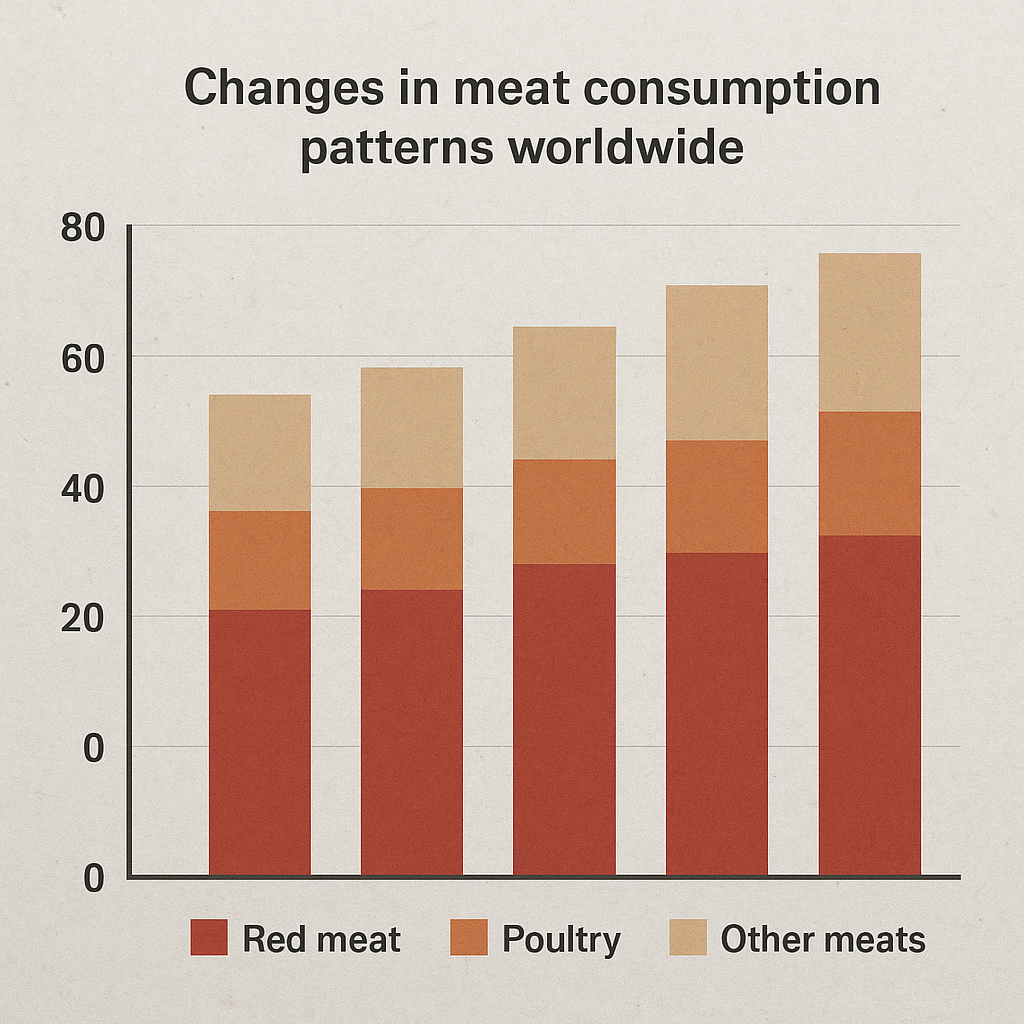
Over recent decades, per capita meat consumption has diverged across regions. In many high-income countries, consumption levels have stabilized or slightly declined after peaking, while in low- and middle-income countries, the demand for animal protein has been rising rapidly. Key drivers include rising incomes, urbanization, and changing dietary preferences. Population growth and shifting age structures also contribute to absolute increases in demand.
Regional patterns show distinct trajectories. In parts of East and Southeast Asia, notably China, pork consumption historically dominated diets but has become more diversified with growing poultry and beef intake. South Asia remains more plant-centric, yet demand for dairy and poultry is increasing as incomes rise. Sub-Saharan Africa exhibits the fastest projected growth rates in total meat demand, although per capita levels remain lower than global averages. Latin America and Oceania continue to be both major producers and significant per capita consumers, with strong export-oriented livestock sectors.
Drivers behind regional variation
- Income growth: Higher disposable incomes typically lead consumers to include more meat and animal products in their diets.
- Urbanization: City lifestyles and supermarket expansion change access and convenience, favoring processed and animal-based foods.
- Cultural preferences: Traditional cuisines and religious practices shape species-specific consumption (e.g., pork vs. beef).
- Price and supply: Feed costs, livestock productivity, and trade policies influence affordability and availability.
Impacts on agricultural markets and supply chains
The rising and shifting demand for animal products has significant implications for agricultural markets. Livestock production is closely linked to crop markets through feed demand; increases in meat production raise global demand for commodities such as soybean meal and maize. This interdependence creates volatility: feed price spikes can quickly translate into higher meat prices, affecting both producers and consumers.
Global supply chains have also become more integrated. Large-scale processors and multinational food companies play central roles in consolidating production, processing, and distribution. While consolidation can improve efficiencies and traceability, it can also concentrate market power, squeezing smallholder producers and limiting producer bargaining power. The spatial separation between feed production regions and livestock production zones drives long-distance trade in both live animals and processed products.
Market risks and opportunities
- Price volatility: Weather, crop yields, and geopolitical events affect feed and meat prices.
- Trade dynamics: Tariffs, sanitary restrictions, and bilateral agreements reshape export opportunities.
- Value chain upgrading: Certification, cold chain investments, and digital traceability open premium markets.
- Contract farming: Offers farmers market access but can lock them into specific buyers and practices.
Environmental and resource considerations
Meat production is resource-intensive. Livestock systems require land for grazing and feed production, consume substantial quantities of water, and contribute significantly to greenhouse gas emissions, notably methane from ruminants and nitrous oxide from manure and fertilizers. Expansion of pasture and cropland for feed has been a driver of deforestation in key regions, with spillover effects on biodiversity and carbon stocks.
Different production systems have varying footprints. Intensive feedlot operations can achieve high productivity per animal, potentially reducing emissions per kilogram of meat, but they raise concerns over manure management, antibiotic use, and animal welfare. Pastoral systems may support livelihoods and ecosystem services but can be vulnerable to climate variability. Life-cycle analyses increasingly inform policy debates by quantifying emissions across feed production, on-farm operations, processing, and transport.
Mitigation pathways
- Feed innovation: Improving feed efficiency and incorporating low-emission feed additives can lower enteric methane per unit of meat.
- Land-use planning: Preventing conversion of high-carbon ecosystems and improving pasture management reduces net emissions.
- Waste management: Better manure handling and biogas capture cut methane and produce renewable energy.
- Consumption shifts: Diversifying diets toward less resource-intensive proteins changes demand-side pressures.
Health, nutrition, and social dimensions
Meat delivers high-quality protein, essential amino acids, and micronutrients such as iron, zinc, and B12, which are particularly important in contexts with limited dietary diversity. However, excessive consumption of certain processed and red meats has been linked to non-communicable diseases. Public health guidelines increasingly balance the nutritional benefits of moderate meat intake against risks associated with overconsumption.
Socially, livestock farming supports rural incomes and cultural identities. Changes in meat demand can alter rural employment patterns: intensification and automation may reduce labor demand on farms while creating jobs in agro-processing and logistics. Policies that support smallholder integration into modern value chains and protect labor standards are critical to ensuring equitable development outcomes.
Technological change and alternative proteins
Innovation is reshaping both production and demand. On the production side, precision livestock farming, genetic improvement, and improved veterinary services boost productivity and animal health. Digital tools enable better feed formulation, disease surveillance, and supply-chain traceability. These technologies can improve efficiency while reducing environmental impacts when adopted at scale.
On the demand side, the rise of plant-based analogues and cultured meat (cell-cultured protein) presents new market entrants that can alter long-term consumption patterns. Although currently a small share of the market, alternative proteins receive increasing investment and regulatory attention. Their environmental benefits depend on energy sources and production methods, but they offer potential for reducing land pressure and certain emissions.
Adoption barriers and scaling challenges
- Cost and price parity: Alternative proteins and advanced production systems often face higher production costs relative to conventional meat.
- Consumer acceptance: Taste, texture, cultural acceptability, and trust determine uptake among different demographic groups.
- Regulatory frameworks: Safety standards, labeling rules, and taxation influence market entry and expansion.
- Infrastructure: Cold chains, processing facilities, and distribution networks are necessary to scale innovations.
Policy, governance, and market instruments
Governments and international organizations play central roles in shaping how meat systems evolve. Policies range from agricultural subsidies and trade measures to environmental regulations and public health advisories. Effective governance seeks to align incentives across multiple objectives: food security, rural development, climate mitigation, and public health.
Market instruments can encourage more sustainable practices. Examples include payments for ecosystem services to conserve pasturelands, emissions trading schemes that include agricultural sources, and public procurement standards that prioritize low-impact products. Labeling programs and certification schemes help consumers make informed choices while rewarding producers who adopt sustainable practices.
Key policy challenges
- Balancing productivity and environmental protection without disadvantaging smallholders.
- Designing fair trade rules that prevent market distortions while enabling access to global markets.
- Harmonizing food safety and innovation-friendly regulations to accommodate novel protein sources.
- Providing social safety nets for communities affected by structural shifts in livestock sectors.
Implications for farmers, traders, and consumers
Farmers face a complex set of choices. Investment in productivity-enhancing technologies can increase competitiveness but requires access to capital, knowledge, and markets. Smallholder producers may benefit from cooperative models, contract farming, and niche marketing (e.g., organic, grass-fed, or regionally branded products). Traders and processors must manage supply chain resilience, traceability, and compliance with international standards.
Consumers increasingly expect transparency about origin, animal welfare, and environmental impact. Retailers and foodservice providers respond with diversified product portfolios, offering lower-meat and plant-based options alongside conventional products. Price sensitivity remains a crucial determinant of choices, particularly in lower-income markets where animal protein fulfills important nutritional needs.
Future scenarios and strategic considerations
Scenario analyses project multiple plausible futures for meat consumption. A business-as-usual trajectory sees continued overall growth in total meat production, driven by population and income growth, with regional shifts. Alternative scenarios incorporate accelerated adoption of alternative proteins, strong policy interventions promoting dietary change, or disruptive technological breakthroughs in low-carbon livestock production. Each pathway has different implications for land use, emissions, and rural livelihoods.
Strategic responses should be context-specific. In regions with undernutrition, policies must improve access to safe, affordable protein while promoting diversified diets. In high-consumption settings, demand-side measures and innovation can reduce environmental footprints without compromising nutrition. Cross-cutting measures include strengthening research and extension services, investing in cold-chain infrastructure, and facilitating smallholder access to finance and markets.
Actions for key stakeholders
- Farmers: Invest in productivity and resilience, adopt best practices for animal health and welfare, and explore value-added markets.
- Policymakers: Design integrated policies that address climate, health, and economic objectives coherently.
- Private sector: Innovate in products, improve supply-chain transparency, and engage in responsible sourcing.
- Consumers and civil society: Advocate for policies and products that support sustainable and equitable food systems.
Research and data needs
Robust, disaggregated data on consumption patterns, production systems, and environmental footprints are essential for evidence-based decision-making. Priority research areas include improving life-cycle assessments of emerging protein sources, understanding socio-economic impacts of transitions on rural communities, and evaluating policy instruments that effectively balance trade-offs among sustainability, nutrition, and livelihoods. Strengthening national and international statistical systems will help monitor progress and guide targeted interventions.
As meat consumption patterns continue to evolve, the agricultural sector must navigate a complex interplay of market forces, technological change, and policy direction. Effective responses will require coordinated action across value chains and sectors, with attention to equity and sustainability alongside productivity and market efficiency. The choices made now will shape the resilience and environmental footprint of global food systems for decades to come.