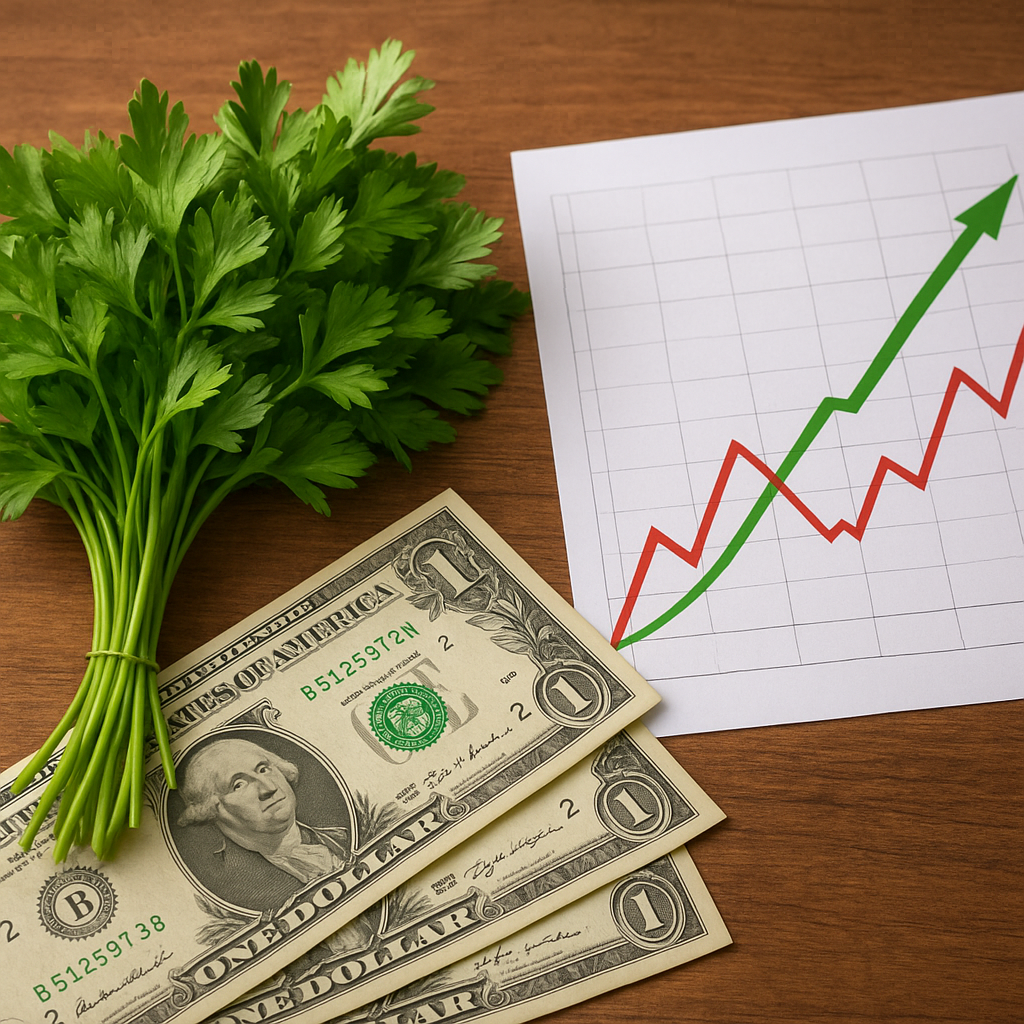
The global market for fresh herbs has undergone notable shifts in recent years, and parsley occupies a unique niche within that evolving landscape. This article examines the forces shaping parsley prices, the structure of the supply chain, and the interactions between producers, traders, retailers and consumers. It highlights practical implications for growers and buyers, and explores how broader trends in agriculture and trade are reflected in the small but economically significant world of culinary herbs.
Market dynamics and price formation
Parsley is a high-value, perishable crop that experiences pronounced fluctuations in wholesale and retail prices. Several interacting factors determine market outcomes: production volumes, transport and storage capacity, consumer preferences, and macroeconomic variables such as currency movements and inflation. Unlike staple grains, parsley prices respond rapidly to short-term shocks because of its limited storability and the tight timing between harvest and consumption.
Supply and demand mechanics
On the supply side, parsley production is influenced by planting cycles, greenhouse capacity, and the availability of labor for delicate harvest and packing tasks. Seasonal peaks lead to surpluses in certain regions, which push down local prices, while off-season reliance on imports can elevate prices sharply. On the demand side, culinary trends and foodservice demand drive consumption patterns: growing interest in fresh and minimally processed meals increases demand for herbs, while shifts away from dining out can depress volumes purchased by restaurants and caterers.
- Regional surpluses: Mediterranean and southern European producers dominate summer supplies to European markets.
- Off-season imports: Latin American producers and controlled-environment agriculture fill winter gaps in the Northern Hemisphere.
- Retail shelf dynamics: Retailers price herbs as loss leaders or premium fresh items depending on store strategy.
Price discovery occurs primarily in wholesale markets and through direct contracts between growers and large retailers or processors. Smaller buyers rely on local markets where spot prices can be volatile. Futures markets do not exist for herbs like parsley, so forward contracts and contract farming are common tools to manage risk.
Production systems, seasonality and costs
Parsley can be produced in open fields, high tunnels, or fully controlled facilities. Each system has different cost structures and risk exposures. Open-field production typically has lower capital costs but higher exposure to weather-related losses, while greenhouse production demands higher initial investment but provides better control over quality and year-round supply.
Seasonality and yield variability
Seasonal cycles drive pronounced yield variability. In temperate zones, peak harvests during late spring and summer generate large volumes that depress prices unless producers invest in post-harvest preservation or processing. Controlled-environment production reduces seasonality effects but increases per-unit costs. Pest pressures, drought, and heat waves can cause sudden yield reductions, contributing to short-run price spikes.
- Labor: Harvesting parsley is labor-intensive; wage rates and labor availability are major contributors to production cost variability.
- Inputs: Fertilizers, irrigation, and packaging (bunching, clamshells) add to unit costs and can vary with commodity prices and regulations.
- Post-harvest losses: High perishability means that even small logistical delays translate into supply reductions and higher market prices.
Producers are increasingly adopting mechanization for planting and some harvesting operations, but complete mechanization is challenging due to the delicate nature of the leaves and the need for hand-sorting to meet retail quality standards. Investments in hydroponic and vertical farming systems are growing, particularly where water scarcity, land costs, or proximity to urban markets justify higher capital expenditure. These systems improve reliability and can command a price premium for year-round availability and consistent quality.
Supply chain, logistics and perishability
The parsley value chain stretches from smallholder plots to large supermarket chains, and the integrity of this chain directly affects final prices. Efficient logistics and cold-chain management are critical: inadequate refrigeration, rough handling, or long transit times result in wilting and product rejection, pushing up effective market prices because of lost volume and perceived lower quality.
Distribution channels and market segmentation
Different distribution channels influence pricing strategies:
- Fresh-cut and pre-packaged herbs for retail demand higher packaging costs but often fetch higher prices due to convenience.
- Foodservice channels require specific pack sizes and may accept lower margins in exchange for large, steady orders.
- Processing (dried or frozen parsley) competes with the fresh market by providing a lower-cost alternative, smoothing demand for fresh parsley in off-seasons.
Export markets add complexity: phytosanitary standards, transit times, and bilateral trade arrangements determine which producers can reliably supply certain regions. Exchange-rate swings can make exported parsley more or less competitive, creating cross-border price differentials that traders exploit.
Price drivers and external shocks
Parsley prices reflect both structural factors and transitory shocks. Understanding these drivers helps market participants anticipate moves and hedge accordingly.
Key drivers
- Supply constraints from weather events or pest outbreaks that reduce harvest volumes.
- Demand shifts driven by consumer preferences, foodservice activity, and emerging culinary trends.
- Macro factors such as inflation, fuel costs, and labor markets that raise production or transport costs.
- Regulatory changes: stricter pesticide regulations or new post-harvest handling requirements can increase compliance costs.
- Volatility in input markets (fertilizers, packaging) which affects unit economics for growers.
Short-term price spikes often follow harvest disruptions or rapid increases in demand during holiday seasons or promotional events. Conversely, technological adoption in production or improvements in cold chain logistics can compress price spreads between seasons, reducing long-run volatility.
Quality segmentation, certifications and consumer preferences
Consumers increasingly value traceability, food safety, and environmental stewardship. These preferences create price differentials across product segments. Certified organic parsley, for example, often sells at a premium relative to conventionally grown product, though higher production costs and lower yields can narrow producer margins if premiums are not sustained.
- Organic certification commands higher prices in many markets, but supply constraints and certification costs limit entry.
- Sustainability credentials—reduced pesticide use, water efficiency, and fair labor practices—are gaining importance and sometimes lead to retailer sourcing programs that support higher prices for compliant suppliers.
- Traceability systems using QR codes or blockchain pilot projects are increasingly used to justify price premiums by linking product back to farm-level practices.
For retailers, the decision to promote parsley as a premium, traceable product or as a low-cost staple impacts ordering patterns and pricing. Foodservice operators may prioritize cost and consistency, while high-end grocers emphasize origin and quality, willing to absorb higher costs for differentiated products.
Risk management and forecasting
Because formal derivatives markets do not exist for parsley, stakeholders use a range of alternative risk-management techniques:
- Forward contracts: Locking in prices for future deliveries with major buyers helps stabilize cash flows.
- Diversified sourcing: Retailers source from multiple regions to smooth seasonal gaps and reduce exposure to local shocks.
- Insurance and contingency planning: Crop insurance and business continuity strategies mitigate extreme weather and logistic disruptions.
- Data analytics: Satellite imagery, local weather models, and field sensors improve yield forecasts and inform pricing decisions.
Forecasting remains challenging due to the sensitivity of parsley to microclimates and input variances. Nevertheless, improved agronomic practices and better real-time data can reduce forecast error and lead to more efficient pricing.
Policy, trade and market access
Trade policy and sanitary measures influence the flow of parsley between producing and consuming regions. Tariffs can make imported herbs prohibitively expensive in some markets, while non-tariff barriers—strict residue limits, packaging requirements, or inspection regimes—create additional costs that affect final prices.
Supportive agricultural policies, such as subsidies for greenhouse adoption or investment in cold-chain infrastructure, can lower production costs and reduce seasonal price swings. Conversely, abrupt policy changes can introduce uncertainty that markets price in via wider spreads and higher retail markups.
Innovation, technology and future directions
Technological advances are reshaping the parsley market. Innovations in controlled-environment agriculture, precision irrigation, and integrated pest management reduce risks and can stabilize supply, thereby exerting downward pressure on extreme price movements. Value-added processing, such as pre-washed bunches or culinary mixes, creates new product categories and revenue streams that can smooth farmer incomes.
Investment in logistics and digital marketplaces also broadens access for small producers to reach distant buyers and access price information that narrows informational asymmetries. As consumer focus on sustainability and food safety intensifies, producers who adopt verifiable practices will likely capture persistent premiums.
Practical recommendations for market participants
- Growers: Diversify production systems and consider staggered plantings or controlled-environment investments to reduce exposure to seasonality.
- Buyers and retailers: Use multi-source procurement and invest in cold-chain verification to reduce spoilage-related price shocks.
- Policymakers: Support infrastructure and training that lower transaction costs and facilitate market access for small-scale producers.
- Investors: Target technologies that improve yield predictability, reduce post-harvest loss, and enhance traceability to capture long-term value.
Parsley may be a small line item in the broader food basket, but its pricing dynamics reflect many of the same forces shaping contemporary agriculture: perishability, seasonality, technological change, and shifting consumer values. Stakeholders who understand and adapt to these forces can better manage risk and capture opportunities as markets continue to evolve.