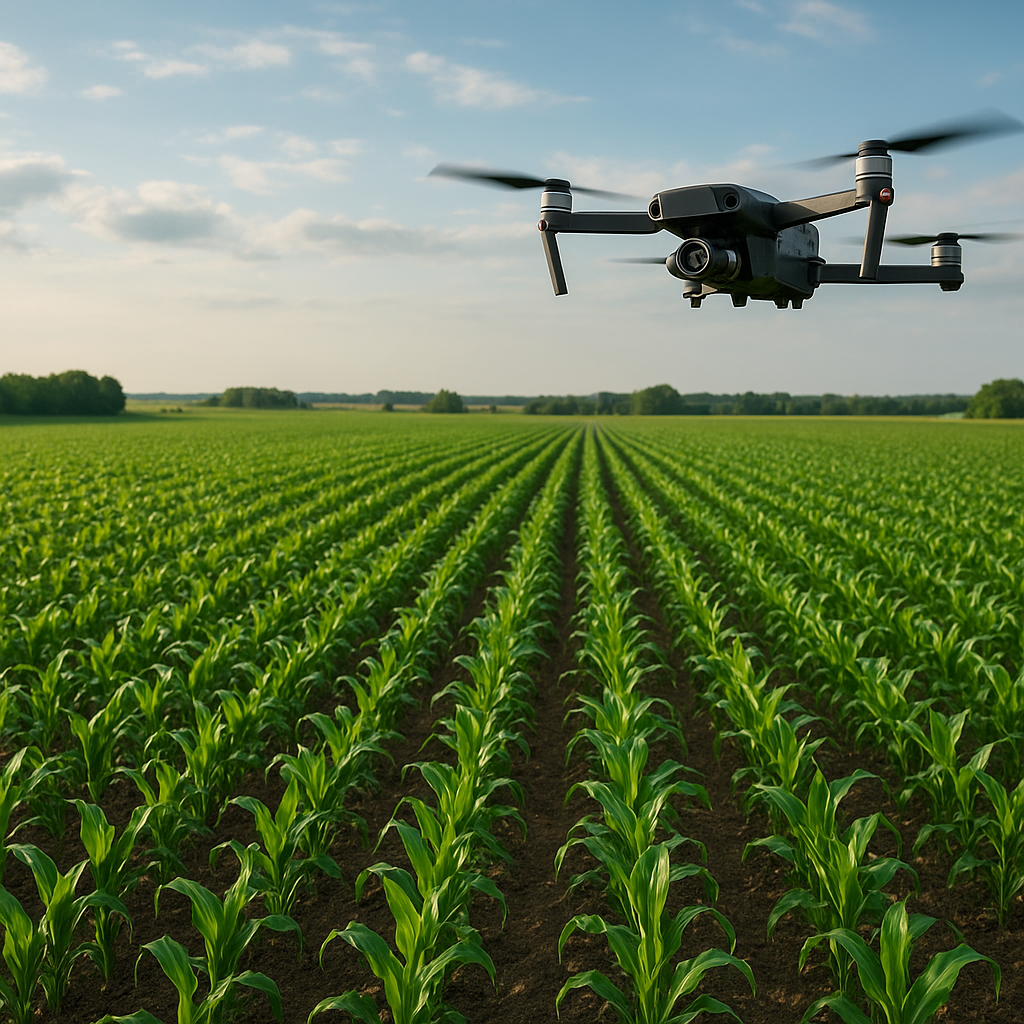
The rapid integration of unmanned aerial systems into agricultural practice is reshaping how crops are monitored, managed and marketed. Drones are no longer novelty gadgets; they are becoming core tools that connect on‑farm decisions with wider supply chain dynamics and market signals. This article explores the technological capabilities of modern aerial platforms, their practical impacts on crop management and farm economics, the evolving market structures that support adoption, and the regulatory and infrastructural challenges that will determine how broadly benefits are realized.
From scouting to smart spraying: capabilities of modern aerial platforms
Contemporary agricultural drones combine robust airframes with a wide array of payloads. High-resolution RGB cameras, multispectral and hyperspectral imagers, thermal sensors and LiDAR units allow growers to gather data at scales and frequencies that were previously impractical. Equally important are the on-board and cloud-based processing tools that transform raw imagery into actionable intelligence—mapping plant vigor, identifying stress hotspots, estimating biomass and guiding targeted interventions.
Sensors and data fusion
Plant-level diagnosis depends on the quality and diversity of data. Multispectral imagery can detect variations in chlorophyll and water content, thermal sensors reveal canopy temperature anomalies associated with water stress or disease, and LiDAR provides precise canopy height and structure metrics. When these streams are combined through advanced analytics, they reveal temporal patterns and causal relationships that enable truly precision approaches to crop management.
Applications: mapping, spraying and pollination support
Typical applications include high-frequency field scouting, variable-rate application of fertilizers and agrochemicals, seedbed mapping and early detection of pests and disease outbreaks. In specialty crops, small drones are being used to support pollination or to deploy beneficial insects. Larger platforms equipped with crop-protectant tanks enable targeted spraying that reduces drift and chemical use, while small quadcopters provide centimeter-level mapping for transplanting and planting decisions. Across these tasks, the combination of mobility, sensor diversity and repeatability is changing operational routines on the farm.
Impacts on crop management and farm economics
For many growers, the net value of drone deployment comes from improved decision timing and resource optimization. By identifying stress zones early, producers can apply inputs more precisely, reduce waste and prevent yield losses. This has a direct effect on margins in commodity crops and can protect premium quality in horticulture and viticulture. Importantly, drones extend the reach of agronomic expertise: consultants and agtech service providers can inspect thousands of hectares remotely, making high-quality advisory services accessible to smaller farms.
Yield, input efficiency and risk management
Several mechanisms link aerial scouting to better outcomes. Early detection of nutrient deficiencies or disease enables corrective actions before problems become widespread, boosting potential yields. Variable-rate applications informed by drone maps improve input efficiency—fertilizer and pesticide are used where they are needed most, lowering costs and environmental exposure. In regions prone to climatic variability, rapid assessment after storms or droughts supports quicker insurance claims and recovery planning, transferring these assessments directly into market and financial workflows.
Labor, scale and new service models
Drones change the labor profile on farms. Routine scouting tasks that once required crews walking long transects can now be performed in hours, freeing human capital for tasks that demand judgement and mechanized skill. At the same time, the economics of drone ownership vary by scale: many producers prefer to hire specialized service providers or cooperatives rather than buy and operate aircraft themselves. This shift fosters new business models—drone-as-a-service, subscription data platforms and integrated input recommendations—creating opportunities for agritech firms and extending technology access to smaller producers.
Markets, adoption and the investment landscape
The global agdrone market is shaped by several intersecting trends: increasing farm consolidation in some regions, rising demand for traceability and sustainability, and the proliferation of sensors and AI. Venture capital and corporate agribusinesses have flowed into companies that can tie aerial sensing to end-to-end decision support—from planting calendars to harvest timing and logistics coordination. As value chains demand higher traceability, drone-derived data frequently becomes input to certification schemes and quality grading, connecting field-level practice with market premiums.
Adoption barriers and incentives
Adoption is unequal across geographies and commodity types. High-value specialty crops (fruits, vegetables, vineyards) often lead in investment because the relative return on improved management is large. Broadacre commodity farms may adopt drones more slowly but can achieve scale efficiencies through service providers and automation of data pipelines. Incentives include yield improvement, reduced input costs and compliance with evolving sustainability standards. Public programs and agri-environmental payments increasingly reward measurable conservation outcomes, where drone monitoring can provide the necessary evidence.
Business models and competition
Market actors include drone manufacturers, sensor companies, software and analytics providers, and field service firms. Integration is a competitive advantage: firms that link flight operations, data processing, decision recommendations and marketplace connections (seed, fertilizer, buyers) tend to capture more value. Partnerships between equipment makers and agricultural cooperatives or input suppliers are common. Meanwhile, open‑platform initiatives and standards for data interoperability are emerging to prevent vendor lock-in and to accelerate adoption across heterogeneous landscapes.
Regulation, ethics and the path to ubiquitous integration
The regulatory environment strongly influences how quickly and safely drones can be integrated into routine agriculture. Airspace rules govern where and when drones can fly, certification requirements affect pilot training, and privacy rules restrict certain forms of data collection. Harmonizing these regulations to balance safety, privacy and innovation is a work in progress in many countries.
Safety, privacy and environmental considerations
Operators must manage collision risk, avoid sensitive sites and maintain data security. There are also ecological concerns: routine spraying by drones can be more targeted, reducing overall chemical load, but improper use could still harm non-target organisms. Ensuring that drone deployment aligns with environmental goals requires best-practice guidelines, training and monitoring. Public acceptance will depend on transparent protocols and demonstrable benefits to communities and ecosystems.
Infrastructure, connectivity and skills
To unlock the full potential of aerial data, farms need robust connectivity for rapid data transfer and integration with farm management systems. Rural broadband and edge-computing solutions are critical enablers. Equally important is human capital: agronomists and operators must learn to interpret drone outputs and incorporate them into management plans. Training programs, extension services and third-party advisory firms play a central role in scaling effective use.
Challenges and future prospects
Several constraints will influence the trajectory of drone use in agriculture. Battery life and payload limitations restrict flight time and spraying capacity, though advances in energy density and hybrid platforms are addressing these barriers. The costs of sensors and analytics are falling, but data standards and interoperability remain immature. Ethical and legal frameworks need to keep pace with technical capability to protect privacy and ensure equitable access.
- Technical bottlenecks: flight endurance, sensor calibration and data integration across platforms.
- Economic hurdles: financing for smallholders, ensuring affordable access through cooperative models.
- Regulatory harmonization: aligning safety, privacy and environmental rules across jurisdictions.
Looking forward, synergy with other technologies will amplify the utility of drones. Integration with satellite imagery, ground sensors and farm machinery enables multi-scale monitoring and closed-loop automation. Machine learning models will improve pest and nutrient diagnosis, pushing recommendations from descriptive mapping toward predictive and prescriptive decision support. As platforms evolve, the role of drones will expand from isolated tools to nodes in a broader digital ecosystem that links soil, plant and market data.
Successful diffusion will depend as much on social and institutional innovation as on hardware. Cooperative service models, standardized data formats and targeted training programs will determine whether the productivity and sustainability gains promised by aerial systems are broadly distributed. For growers, agribusinesses and policymakers, the priority should be to foster environments where data-driven management enhances resilience, improves input efficiency and connects production decisions to market signals that reward higher quality and lower environmental impact. By doing so, the agricultural sector can harness the capabilities of drones in ways that benefit producers, consumers and ecosystems alike.
In practice, implementing these systems requires coordinated investments in infrastructure, regulatory clarity and capacity building. Private investment will drive much of the innovation, but public support for research, rural connectivity and extension services will ensure equitable access. Farmers and service providers must develop trust in the algorithms and workflows that translate aerial observations into field actions. When these pieces come together, the potential to transform crop management at scale becomes tangible: fewer wasted inputs, earlier interventions, better alignment with market demand and more resilient agricultural systems.