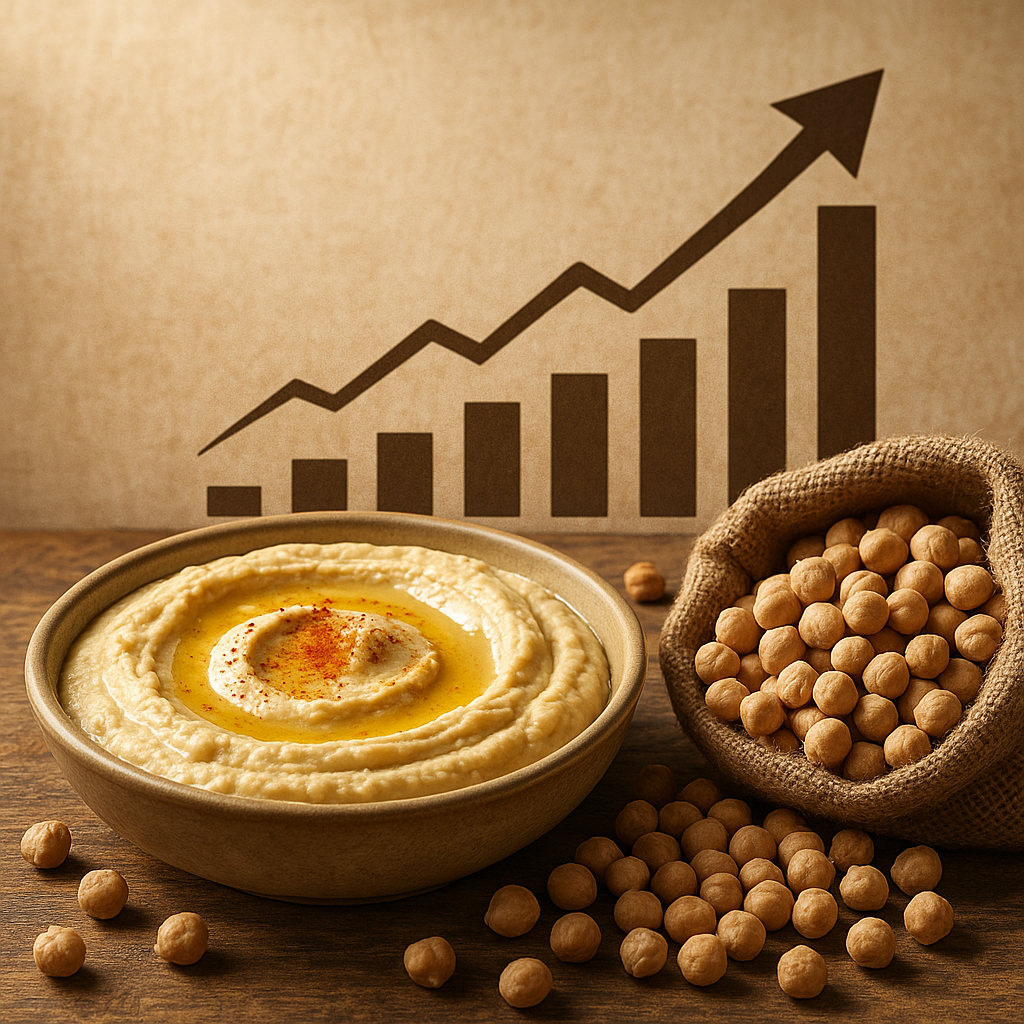
The rise of hummus from a regional staple to a global pantry favorite has reshaped agricultural markets and created new opportunities and stresses along the chickpea value chain. As consumer tastes evolve and plant-based diets gain traction, the ripples of changing demand propagate from supermarket shelves back to fields, processors and international trade lanes. This article examines how shifting demand for a single food product influences crop choices, price formation, sustainability practices and the broader economics of pulse agriculture.
Market dynamics driving hummus popularity
Several interlinked factors explain why hummus has moved from niche ethnic aisles into mainstream consumption. First, rising interest in healthy, protein-rich, plant-based foods has increased household purchases of legumes and legume-based products. Second, aggressive product innovation and marketing by large food companies and private labels have diversified hummus flavors, packaging formats and price points, making the product attractive to wide demographic groups. Third, foodservice growth and casual dining trends have placed hummus on menus internationally, stimulating steady demand beyond retail.
Consumer preferences and nutritional trends
Modern consumers often seek convenient sources of fiber and vegetable-based protein. Chickpea-based foods fit that niche well, and hummus benefits from being perceived as both healthy and versatile. The cultural diffusion of Mediterranean and Middle Eastern cuisines has also normalized hummus consumption in markets that previously offered little exposure.
Retail and food-industry drivers
Retailers have expanded hummus offerings, introducing private-label products that compete on value and forcing branded producers to innovate. Food processors have invested in automation and extended shelf-life technologies that allow hummus to be distributed more widely and stocked in more outlets. These commercial developments transform a formerly localized demand signal into sustained, predictable demand for chickpeas.
Production, supply response and agronomic implications
At the farm level, increased demand for chickpeas encourages acreage shifts and changes in crop rotations. Legumes like chickpea offer agronomic benefits — notably their ability to fix nitrogen and improve soil structure — which can influence farmers’ cropping decisions beyond pure price signals. However, the supply response is shaped by production constraints, input costs and climate variability.
Global production patterns
India remains the largest producer and consumer of chickpeas, but export-oriented production in countries such as Australia, Turkey and Mexico has expanded to serve global markets. Exporters with irrigated or mechanized agriculture can scale output more quickly, while smallholder-dominated regions may face limits on rapid expansion without investment in seed, machinery and logistics.
Farmer decisions and rural incomes
Higher market prices for chickpeas can improve farmers‘ incomes, particularly in regions where pulses are underutilized. Some growers respond by reallocating land from cereals or oilseeds to chickpea. Yet such shifts carry risks: monoculture expansion reduces crop diversity, heightens pest and disease exposure, and can undermine long-term resilience. Policies that support balanced rotations, crop insurance and access to quality seed help mitigate these risks.
Soil fertility and resource use
Chickpeas’ role as a legume means they contribute to soil nitrogen, reducing synthetic fertilizer needs for subsequent crops. This ecological service factors into farm-level sustainability calculations and can lower input costs. Nonetheless, chickpeas are sensitive to planting windows and moisture stress; therefore, climate variability and irrigation access remain critical determinants of yield stability.
Price transmission, market volatility and trade
As demand for hummus climbs, the price of raw chickpeas reacts to real supply constraints, speculative buying and logistical bottlenecks. Because chickpeas are not widely represented in major futures exchanges, price formation can be more responsive to immediate physical market imbalances and bilateral trade decisions.
International trade and policy impacts
Trade flows of chickpeas determine which producing regions benefit from the hummus boom. Export policy, phytosanitary standards and tariffs can redirect flows and create sudden price swings in importing countries. For example, export restrictions in a major producing country or abrupt changes in import duties can trigger local shortages and price spikes for processors dependent on consistent raw material supply.
- Export bans and quotas increase short-term price volatility.
- Sanitary and phytosanitary requirements add compliance costs for exporters.
- Exchange rate movements can make exports more or less competitive, affecting planting decisions.
Price effects along the value chain
Price increases for chickpeas translate into higher input costs for processors and may compress retail margins unless consumers accept higher retail prices. On the other hand, processors who invest in improved storage and diversified sourcing can buffer themselves from short-term shocks. The lack of deep financial markets for pulses means that many participants rely on informal contracts and spot markets, which can exacerbate uncertainty.
Processing, value addition and supply chain transformation
Growth in hummus consumption has pushed innovations in processing and packaging. Economies of scale in manufacturing, cold-chain logistics and branded product differentiation have all contributed to a reorganized value chain that favors larger, integrated firms but also opens opportunities for niche, artisanal producers.
Vertical integration and contract farming
Some processors secure supply through contract farming arrangements, providing seed, technical assistance and guaranteed purchase terms to growers. These models reduce sourcing risk and can improve quality consistency, but they also introduce power imbalances that require transparent contract terms to protect smallholder interests.
By-products and alternative uses
Processing chickpeas for hummus also yields by-products such as hulls and aquafaba (the viscous liquid from cooked chickpeas), which have found uses in food formulations and as vegan egg substitutes. Diversifying end uses increases overall value per ton of chickpeas and encourages more robust investment in storage and processing infrastructure.
Sustainability, climate risk and social considerations
Expanded chickpea production intersects with environmental goals and social dynamics. Compared with certain water-intensive cash crops, chickpeas can be a relatively water-efficient protein source, and their nitrogen-fixing properties contribute to lower synthetic fertilizer use, benefiting sustainability agendas. Yet the environmental footprint depends heavily on local agronomic practices and irrigation regimes.
Climate change and yield variability
Rising temperatures and shifting precipitation patterns threaten chickpea yields in marginal areas. Droughts during critical growth stages can dramatically reduce yields, making supply less predictable. Investment in climate-resilient varieties and water management is essential to maintain supply reliability as demand grows.
Equity and smallholder livelihoods
While higher chickpea prices can boost rural incomes, benefits are uneven. Smallholders without access to markets, storage or credit may be unable to scale production. Strengthening cooperative models, improving extension services, and ensuring fair contract terms are key to inclusive growth.
Technology, innovation and future prospects
Technological advances will shape how agriculture responds to sustained hummus demand. From improved seed genetics to precision agriculture and digital platforms for market information, innovation reduces transaction costs and raises productivity. Innovation in breeding has produced varieties with better yield, disease resistance and adaptation to short-season environments, enabling expansion into new growing areas.
Mechanization and post-harvest technologies
Mechanized planting and harvesting reduce labor bottlenecks and lower production costs, while better drying, cleaning and storage reduce post-harvest losses that can otherwise erode farmer income. Investments in rural logistics, such as collective storage facilities, help stabilize supply and reduce price volatility.
Digital marketplaces and traceability
Digital platforms that match buyers and sellers can improve price discovery and contract transparency. Traceability systems—driven by consumer demand for provenance—can add value to sustainably produced chickpeas and enable premium pricing for verified supply chains.
Policy levers and recommendations
Policymakers and industry stakeholders can influence how the hummus boom translates into long-term benefits. Effective interventions focus on managing volatility, supporting sustainable intensification and ensuring inclusive value chains.
- Support research into climate-resilient chickpea varieties and promote on-farm conservation practices.
- Facilitate access to finance and insurance for smallholders to enable acreage adjustment without excessive risk.
- Encourage transparent contracting and strengthen cooperative models to balance bargaining power between processors and growers.
- Invest in post-harvest infrastructure and cold chains to reduce losses and improve supply reliability.
- Align trade policies with market realities to avoid abrupt distortions that create volatility for processors and consumers alike.
The unfolding story of hummus and chickpeas illustrates how a shift in consumer preferences can cascade through agricultural systems, prompting changes in production, trade and technology. As markets continue to adapt, stakeholders across the chain — from breeders and farmers to processors and retailers — will need to coordinate investments and policies that support resilient, equitable and environmentally sound growth.