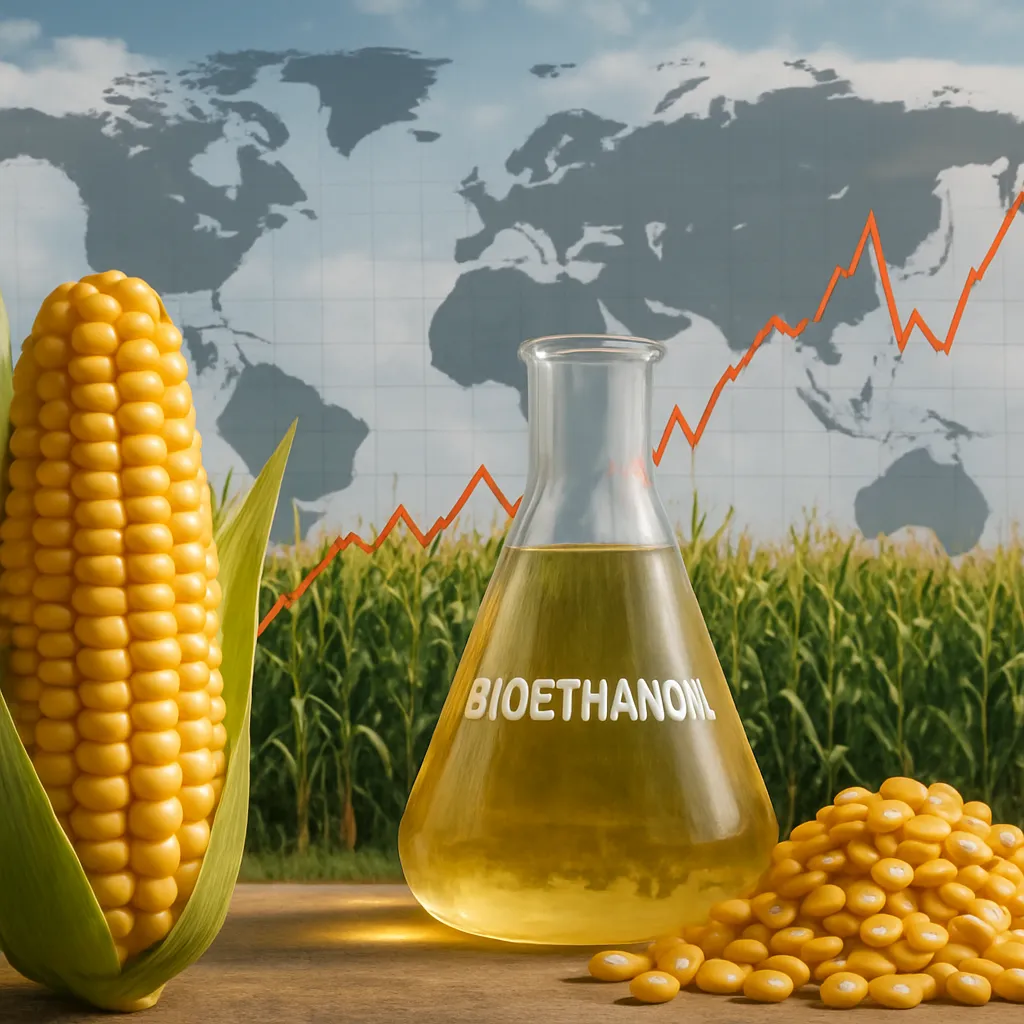
Global agricultural markets are shaped by a web of interlinked forces: energy policy, trade flows, climatic variability, and evolving consumer preferences. One of the clearest examples of this interplay is the influence of biofuel production—particularly **bioethanol**—on the global market for **corn**. As nations pursue renewable energy targets and seek alternatives to fossil fuels, the resulting rise in **demand** for bioethanol has a ripple effect across commodity **prices**, farm incomes, land use, and food systems. This article explores the mechanisms by which bioethanol affects corn markets, the economic and policy drivers behind the trend, and the environmental and socio-economic consequences that follow.
How bioethanol demand transmits to corn markets
The most immediate channel linking bioethanol to corn prices is straightforward: in many regions, especially the United States, corn is the primary feedstock for ethanol production. When ethanol plants increase output, they absorb a larger share of the corn crop, tightening supply available for other uses such as animal feed and exports. Market fundamentals—supply, demand, and stocks—react accordingly, and prices adjust.
Supply-demand balance and elasticity
Corn supply is influenced by acreage, yields, and stocks. Because planting decisions are made months before harvest, supply responds with a lag to price signals. On the demand side, ethanol plants provide a sizable, relatively inelastic source of consumption: once production capacity and blending mandates exist, ethanol demand for corn is stable and predictable up to a point. This asymmetry means that sudden shocks to corn supply—droughts, floods, or pest outbreaks—can produce larger price swings when a significant portion of the crop is committed to ethanol.
Price transmission and co-products
Another important factor is the production of co-products from ethanol processing, notably distillers dried grains with soluble (DDGS). DDGS partially substitute for corn and soymeal in livestock rations, softening the impact of corn diversion to ethanol. However, the substitution is imperfect: transport costs, nutritional differences, and regional feed markets limit full offset. Futures and options markets on exchanges like the CME also amplify price information and can increase short-term volatility as traders hedge ethanol exposure or speculate on expected policy changes and weather outcomes.
Economic and policy drivers behind ethanol expansion
Several interlocking policies and economic conditions have driven expansion of ethanol production. Governments use mandates, subsidies, tariffs, and tax incentives to support domestic biofuel industries. In the United States, the Renewable Fuel Standard (RFS) set blending targets that created a long-term demand floor for ethanol. Other jurisdictions rely on blending requirements or tax breaks to promote energy security and reduce greenhouse gas emissions from transport.
- Mandates and blending targets create predictable demand streams for ethanol producers, encouraging investment in processing capacity.
- Subsidies and tax credits lower the effective cost of ethanol relative to gasoline, expanding consumption beyond what market forces alone would generate.
- Tariffs or import restrictions can protect domestic producers but may raise local corn prices by insulating markets from cheaper international supplies.
Global oil prices also matter. When crude prices are high, gasoline prices rise, making ethanol blends more competitive even without policy support. Conversely, prolonged low oil prices compress margins for ethanol producers and can reduce the incentive to expand corn usage for fuel. Technological progress—both in agricultural productivity and ethanol conversion efficiency—changes the economics too. Improved corn yields increase supply and can moderate price impacts, while advances in ethanol processing reduce the amount of corn needed per liter of fuel or open pathways to second-generation biofuels that use waste biomass rather than food crops.
Environmental and social consequences
Linking energy policy to agricultural production creates a set of trade-offs. On one hand, substituting biofuels for fossil fuels can reduce greenhouse gas emissions over the fuel life cycle if feedstocks are produced sustainably. On the other hand, expansion of corn acreage—especially into previously uncultivated lands—can produce **land use** changes that release carbon and undermine emission benefits. Indirect land use change (ILUC) remains a contested area of life-cycle analysis because it attempts to capture how increased demand for crops displaces other agricultural activities globally.
Food security and price volatility
Higher corn prices driven by ethanol demand can raise food costs directly and indirectly. Corn is both a staple food in many low-income countries and a major input for livestock and food processing. Price rises transmit to bread prices, meat and dairy costs, and to households with limited ability to absorb shocks. In periods of tight supply, governments may impose export restrictions to protect domestic consumers, further tightening global markets and increasing volatility.
Biodiversity, water, and soil impacts
Intensified corn production can have local environmental impacts: increased fertilizer and pesticide use, greater water withdrawals for irrigation, and loss of biodiversity as monocultures expand. These factors also influence long-term productivity: soil degradation and reduced water availability can undermine future yields and exacerbate price instability. Sustainability certifications and best-practice agricultural measures (no-till farming, nutrient management) can mitigate harms, but they require enforcement and sometimes additional investment by farmers.
Market responses and adaptation strategies
Markets and policymakers are not passive. Farmers, processors, and governments adopt strategies to manage the risks arising from the bioethanol-corn nexus.
Farmers and supply-side adaptation
Farmers respond to higher corn prices by planting more corn, shifting acreage from other crops, or investing in yield-enhancing inputs. Crop insurance and forward contracts help manage risk, while improvements in agronomy and seed technology raise productive capacity. However, crop switching is constrained by crop rotations, climatic suitability, and capital availability.
- Crop diversification reduces farm-level exposure to corn price swings.
- Investment in irrigation or resilient seed varieties can stabilize yields but may increase environmental costs if not managed sustainably.
- Value-chain integration—farmers contracting with ethanol mills—provides price certainty but can limit farmer bargaining power.
Policy adjustments and international coordination
Policymakers are increasingly aware of the spillovers from biofuel policy to food markets. Some options to reduce negative impacts include making mandates more flexible (e.g., allowing waiver mechanisms during tight harvests), targeting incentives toward non-food feedstocks (cellulosic ethanol), and implementing sustainability criteria that discourage land conversion. Improved grain market transparency—timely data on stocks, production, and trade—helps reduce speculation-driven volatility.
Technological pathways
Long-term mitigation of the food-versus-fuel tension depends heavily on technology. Second-generation biofuels that use agricultural residues, dedicated energy crops on marginal land, or microbial processes that convert waste into fuels can decouple transport fuel supply from staple food crops. Scaling these technologies requires sustained R&D, pilot deployment, and supportive policy frameworks that recognize varying regional capabilities.
Regional patterns and trade dynamics
Regional variations matter. The United States, with its large corn surplus and extensive ethanol industry, exerts outsize influence on global corn prices. Brazil offers an interesting contrast: sugarcane-based ethanol dominates there, easing pressure on corn markets, though corn expansion can still occur due to biofuel-driven land-use changes for other crops. In regions with small domestic ethanol sectors, global price shifts driven by major producers can still affect local food prices and farm incomes through trade linkages.
Exchange rates, shipping costs, and trade policies mediate these effects. For example, a depreciation of a currency can make imported corn more expensive, magnifying domestic impacts from global price increases. Conversely, liberalized trade can help stabilize regional markets by allowing grain flows from surplus to deficit areas, assuming sufficient infrastructure and predictable policies.
Looking ahead: balancing energy, food, and environment
Designing policies that deliver renewable energy objectives without undermining food affordability or environmental goals is a continuing challenge. Effective approaches tend to combine flexible demand-side measures, support for technological transition to non-food feedstocks, and investments in agricultural sustainability. Market instruments—such as improved grain storage systems, strategic reserves, and better risk-management tools—also improve resilience.
The intersection of **biofuels**, commodity **markets**, and farming systems highlights the need for integrated analysis: energy policies cannot be crafted in isolation from agricultural realities, and agricultural strategies must consider broader energy and climate commitments. As stakeholders—from farmers to policymakers—navigate competing objectives, transparency, targeted incentives, and investment in sustainable technologies will be central to minimizing trade-offs and maximizing co-benefits across the food-energy-environment nexus.