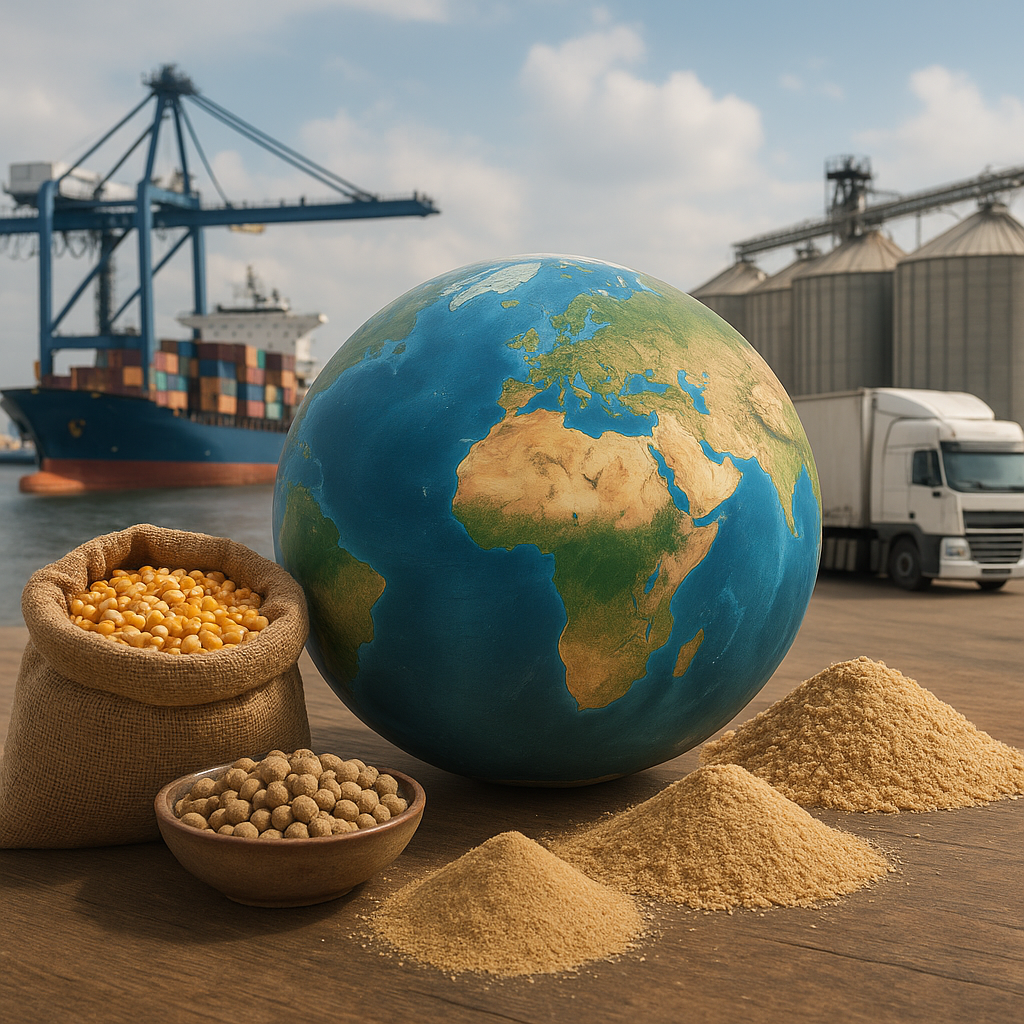
The global trade in feed ingredients sits at the intersection of agriculture, industry and policy, shaping livestock productivity and food security across continents. Rapid changes in demand patterns, shifts in production geography and evolving regulatory landscapes mean that stakeholders — from smallholder farmers to multinational traders — must navigate a complex environment. This article examines market dynamics, supply chain vulnerabilities, and emerging opportunities in the trade of feed components, offering insight into how the sector can adapt to serve a growing population while addressing environmental and social concerns.
Global market dynamics and trade flows
Trade in feed ingredients has expanded significantly over recent decades as populations urbanize and per-capita meat, dairy and aquaculture consumption rises. Key exported commodities include soymeal, maize, barley, canola meal and various oilseed cakes, as well as processed products like distillers’ dried grains. Major exporting regions such as North and South America, the Black Sea, and parts of Southeast Asia influence global availability and price formation. Trade routes are shaped by comparative advantages in climate, technology and scale, but are also sensitive to policy interventions and weather-related shocks.
Price transmission and volatility
International commodity prices transmit quickly through local markets, affecting feed mill margins and ultimately animal product prices. Volatility is driven by factors including biofuel demand, currency swings, and speculative activity. Traders and feeders increasingly use futures, options and other financial instruments to hedge exposure, but small producers often lack access to these tools, making them vulnerable to short-term price spikes.
Shifts in demand
Dietary change in emerging economies has sustained growth in feed demand, while in developed markets efficiency gains and changing consumer preferences influence ingredient mixes. There is a notable trend towards higher inclusion of protein-dense meals to support intensive animal systems, and an increasing interest in alternative feed materials to reduce costs or meet sustainability goals.
Supply chains: risks, resilience and logistics
Long, interconnected supply chains underpin the global feed trade. While these networks allow specialization and efficiency, they also create systemic vulnerabilities. Disruptions from extreme weather events, port congestion, labor shortages and geopolitical tensions can rapidly constrain flows. Strengthening resilience requires investments in infrastructure, diversified sourcing strategies and improved risk management tools.
Biosecurity and traceability
Pathogen transmission through contaminated feed ingredients is a critical concern. Strengthening biosecurity measures across production and processing points is essential to protect animal health. Traceability systems that record origin, handling and processing steps help detect and manage outbreaks more effectively. Technologies such as blockchain and advanced barcoding can enhance transparency, but adoption depends on cost-effectiveness and interoperability across actors.
Logistics and cold-chain considerations
Moving bulk ingredients across continents requires efficient port handling, storage capacity and inland transport. Bottlenecks in any segment elevate costs and spoilage risk. Some specialty ingredients, such as enzymes and probiotics, demand controlled temperatures and timely delivery; thus, robust logistics and storage solutions are increasingly important for maintaining ingredient quality and efficacy.
Sustainability, environmental impacts and regulatory drivers
Environmental scrutiny of agriculture is reshaping feed markets. Concerns over land-use change, greenhouse gas emissions and biodiversity loss have elevated the importance of sustainable sourcing. Private standards and public regulations are pushing supply chains to account for the environmental footprint of feed ingredients. Efforts to reduce deforestation, improve fertilizer use efficiency and adopt regenerative practices are gaining traction.
Certification and market signals
Certification schemes certify that ingredients meet specific environmental or social criteria, creating market segmentation. Buyers may pay premiums for certified soy or palm kernel products that demonstrate minimal conversion of native ecosystems. However, certification adds costs and requires supply chain verification, which can pose barriers for smallholders seeking market access.
Policy and trade measures
Tariffs, quotas and sanitary import measures shape competitive positions. Governments employ support mechanisms — such as subsidies for biofuel feedstock — that can reallocate feed-grade cereals away from animal production, raising prices. Furthermore, sustainability-related regulations, including deforestation-free supply chain laws in some importing jurisdictions, create compliance obligations for exporters and intermediaries.
Innovation and alternative ingredients
Technological progress is broadening the palette of viable feed inputs. Novel proteins from insects, microalgae, single-cell organisms and fractionated plant proteins present opportunities to reduce reliance on traditional oilseed meals. Innovations in precision fermentation enable tailored amino acid profiles and functional additives that enhance feed conversion ratios. These alternatives respond to concerns about land use, sustainability and resilience but must demonstrate consistent nutritive value and cost competitiveness.
Nutrition and feed formulation
Advances in animal nutrition science and feed formulation software enable more efficient use of raw materials. Precision feeding strategies reduce waste and nutrient excretion, advancing both economic and environmental goals. The integration of feed enzymes, probiotics and tailored mineral programs can improve digestibility and lower the need for high-inclusion protein meals.
Scaling constraints
While promising, many alternative ingredients face scaling and regulatory hurdles. Production costs remain high for some bioprocessed proteins, and regulatory approvals for insect meals or novel microbial proteins vary across regions. Developing robust supply chains for these inputs will require investment, consistent quality control and consumer acceptance for the end products.
Market opportunities for producers, traders and feed manufacturers
Emerging market conditions create avenues for value creation at multiple points in the chain. Producers who adopt improved agronomic practices can gain access to premium markets and secure long-term contracts. Traders who develop integrated services — combining procurement, risk management and logistics — can capture margins by offering reliability and compliance support. Feed manufacturers that invest in formulation flexibility and quality assurance can respond to shifting ingredient availability and meet niche customer demands.
- Value-addition: Processing raw oilseeds near origin to produce higher-value meals can increase returns for producing regions.
- Diversification: Sourcing from multiple regions mitigates localized risks and can stabilize supply during shocks.
- Vertical integration: Firms that control multiple stages — from sourcing to distribution — are better positioned to ensure traceability and compliance.
Risk management and strategic considerations
Effective risk management blends market intelligence, contractual safeguards and operational flexibility. Long-term supply contracts, indexed pricing mechanisms and the use of financial hedging instruments reduce exposure to price swings. Building relationships with a network of suppliers, including developing local procurement channels, can enhance responsiveness to disruptions. Investments in digital monitoring of inventories, shipment tracking and quality testing increase transparency and operational efficiency.
Role of data and analytics
Data-driven decision-making improves forecast accuracy for feed demand and helps optimize procurement timing. Satellite-based yield estimates, weather analytics and machine-learning models can provide early warning of supply shortfalls. Integrating these tools into procurement platforms enables agile responses to changing market signals.
Social dimensions and community impacts
The trade in feed ingredients intersects with rural livelihoods. Commodity markets influence farmer incomes, land-use choices and labor dynamics. Policies and private initiatives that prioritize smallholder inclusion — through capacity building, access to finance and market linkages — can ensure that benefits from global trade are broadly shared. However, expansion of export-oriented cropping systems can create tensions with local food security if not managed carefully.
Equity and access
Ensuring equitable access to new technologies, certifications and market information is key to creating inclusive value chains. Cooperative models and aggregator services can help smallholders meet quality standards and aggregate volumes that attract buyers. Public-private partnerships can support infrastructure investments and training programs that strengthen local supply base.
Conclusion: strategic pathways forward
The international trade in feed ingredients will continue to evolve under the influence of demographic trends, environmental constraints and technological change. Stakeholders who proactively manage risk, embrace innovation and invest in transparent, sustainable practices will be best placed to seize opportunities. Balancing productivity, resilience and social responsibility will remain central to building feed systems that support both economic goals and planetary boundaries. The path forward involves coordinated action across public policy, private investment and research to ensure reliable, efficient and sustainable supply chains for the growing protein needs of global populations.