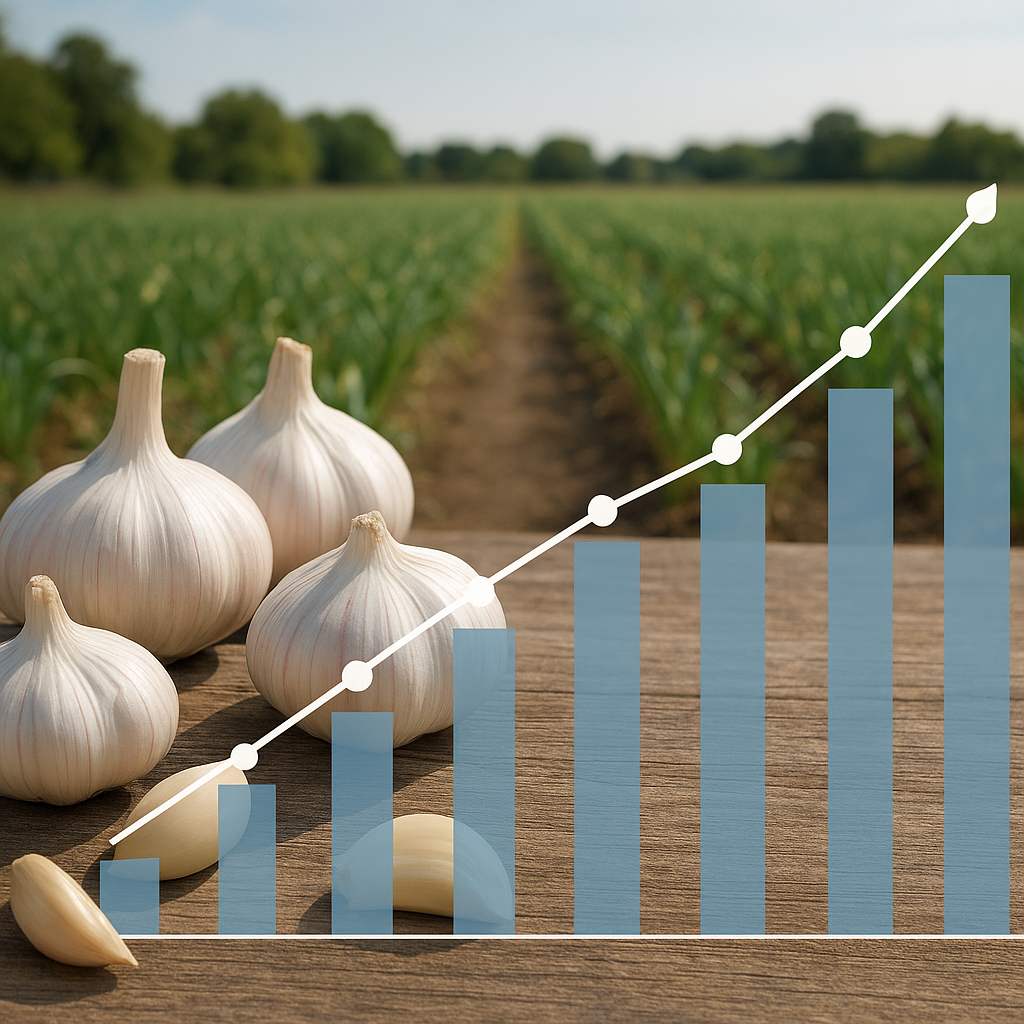
The following analysis explores contemporary trends and future projections for garlic within the broader context of agricultural markets, supply chains and rural economies. It combines insights on production patterns, trade dynamics, technological change and policy pressures to offer practical perspectives for farmers, traders, processors and planners. Emphasis is placed on drivers that will shape global and regional outcomes over the next decade.
Global production patterns and structural shifts
Garlic occupies a distinctive niche among horticultural crops: it is both a staple ingredient and a high‑value specialty crop with varied uses across culinary, medicinal and industrial segments. The global footprint of garlic production remains highly concentrated. China accounts for the largest share of output, producing the majority of the world’s supply, while countries such as India, Bangladesh, Egypt, Spain and the United States are important regional producers. Key structural features of the sector include fragmented smallholder plots in some countries, larger commercial farms elsewhere, and wide differences in yield and agronomic practices.
Several trends define recent structural change:
- Consolidation and specialization in leading producing regions that enables economies of scale and more efficient production systems.
- Geographic diversification driven by rising global demand and concerns about supply concentration, leading investors to explore new production zones with lower land costs or favorable climates.
- Shifts in cropping intensity and irrigation patterns as growers respond to water availability and input cost pressures.
Varieties and agronomy
Varietal choice impacts marketability and storage life—hardneck and softneck types suit different market niches. Best practices such as disease-free seed selection, crop rotation, timely curing and cold storage are increasingly important to maintain quality and reduce post-harvest losses. Adoption of certified planting material and integrated pest management are rising where export markets demand phytosanitary compliance.
Market dynamics, trade flows and price formation
The global garlic market is characterized by strong export flows, concentrated supply, and price cycles that reflect both seasonal harvests and longer-term shocks. Trade patterns are shaped by comparative advantage, logistics costs and sanitary regulations. China’s dominant role as exporter has given it significant influence on world markets and prices, but that influence is moderated by rising production in other countries seeking to capture niche or value-added segments.
- Demand drivers: rising per-capita consumption in emerging markets, culinary trends (e.g., globalized cuisines), and the popularity of value-added garlic products (powders, pastes, oils).
- Supply-side constraints: weather volatility, disease outbreaks (e.g., white rot), labor shortages and input cost inflation.
- Trade policy and non-tariff barriers: quality standards, quarantine measures, and labeling requirements that can create market access advantages or barriers.
Price formation is influenced by the seasonal cycle—harvest peaks depress local prices while off-season imports or stored supplies set higher prices. Processors and retailers manage risk via forward contracting, inventory management and diversifying sourcing. For smallholders, however, price volatility can translate into income risk without access to storage or contract arrangements.
Technological, environmental and policy drivers of change
Future trajectories for garlic are shaped by an interplay of technology, environmental change and policy. Adoption of precision farming tools, improved irrigation and mechanization is uneven but growing where labor costs rise and farms scale up. Meanwhile, climate variability imposes new constraints and opportunities.
Climate and sustainability
Garlic is sensitive to temperature and water regimes. Increased drought frequency and shifting precipitation patterns alter planting windows and yields. Regions that can access irrigation and adapt planting schedules are better positioned, but water scarcity in many major producing basins poses a systemic risk. Growing interest in sustainable and organic production creates premiums in some markets but also requires investment in soil health and pest management.
Innovation in production and post-harvest
Technological advances that matter for the sector include:
- Mechanized planting and harvesting to reduce labor dependency and improve timeliness.
- Improved storage technology (controlled atmosphere, humidity management) to extend shelf life and smooth supply over the off-season.
- Digital tools for yield forecasting, market intelligence and input management that reduce uncertainty and improve efficiency.
Research in breeding aims to produce varieties with better disease resistance, longer shelf life and adapted phenology under changing climates. Public–private partnerships and extension services play roles in disseminating innovations to smaller producers.
Forecasting methods and scenario outlooks
Reliable forecast information is critical to market participants. Forecasting in garlic combines meteorological inputs, remote sensing, field surveys and econometric or machine learning models that capture seasonality and structural trends. Scenarios are useful to capture uncertainty:
- Baseline scenario: moderate demand growth driven by population and income increases, with supply expanding gradually as new areas and improved practices offset losses—prices remain range-bound with seasonal peaks.
- Supply shock scenario: severe climate events or widespread disease reduce output in major producing regions, causing short-term price spikes and encouraging rapid investment in alternative supply sources.
- Technology-adoption scenario: accelerated mechanization and adoption of disease-resistant varieties increase average yields and lower unit costs, expanding exports from mid-sized producing countries and compressing global prices.
Under plausible assumptions, global garlic consumption is expected to grow annually but at a moderate pace. Regional differences will be important: per-capita consumption in parts of Asia stays high while growth in Africa and Latin America may outpace supply expansion, creating import demand. Investors and policymakers should monitor planting intentions, early-season weather and inventories to refine short-term forecasts.
Regional dynamics, value addition and investment opportunities
Different regions offer distinct opportunities:
- East Asia (China, Korea): consolidation, processing capacity and export specialization in low-cost, bulk supply.
- Southern Europe (Spain, Italy): high-value table garlic, organic niches and proximity to EU markets supporting premium pricing.
- North Africa (Egypt): export-oriented expansion to Europe and the Middle East because of favorable seasonal windows and competitive production costs.
- North America: a mix of domestic production in regions like California and significant import dependence for off-season supply; value-added product growth (ready-to-use garlic) is a notable trend.
Value addition—through drying, freezing, milling, and ready-to-use forms—creates new margins and reduces perishability. Contract farming models, vertical integration by processors and investment in cold chains are common strategies to secure consistent quality and supply.
Risks, policy recommendations and practical steps for stakeholders
Risks in the garlic sector include biological threats, extreme weather, market concentration, and trade disruptions. Stakeholders can adopt several practical measures to mitigate exposure and capitalize on opportunities:
- Farmers: diversify crop rotations, use certified and disease-free seed, adopt water-saving irrigation and consider cooperative storage to capture seasonal premiums.
- Processors and traders: invest in multi-sourcing strategies, improve storage infrastructure and build demand through product innovation and branding for differentiated garlic products.
- Policymakers: facilitate access to quality seed systems, support research on resilient varieties, and design trade policies that balance market access with phytosanitary safeguards.
- Investors: look for opportunities in processing capacity, cold-chain logistics and data services that support forecasting and supply chain optimization.
Longer-term resilience depends on coordinated efforts across the value chain to improve traceability, reduce post-harvest losses and enhance environmental sustainability. Strengthening extension networks and market information systems will help smaller producers connect to higher-value channels and reduce vulnerability to price swings. At the same time, monitoring global developments—such as shifts in major exporter production and new trade barriers—remains essential to anticipate and respond to rapid market changes.