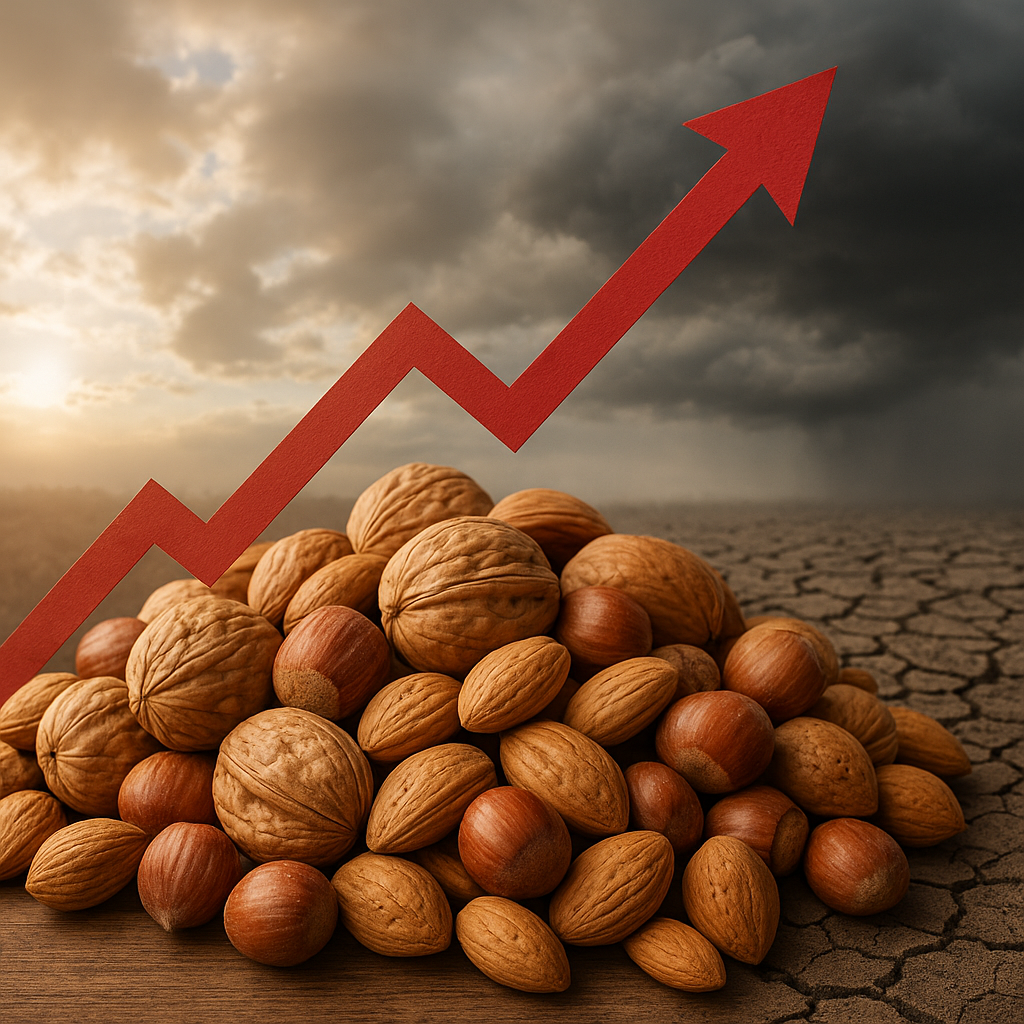
The global appetite for tree nuts — almonds, walnuts, pistachios, cashews and hazelnuts — has surged over the past two decades, reshaping landscapes, trade flows and farm economics. This article examines how rising consumption intersects with growing climate-driven risks to yield, and what that means for farmers, markets, and policy makers. We explore supply-side pressures, market reactions, and practical strategies to sustain production while safeguarding rural livelihoods and ecological integrity.
Demand dynamics and market transformation
Changing diets, health campaigns and food industry innovation have pushed global demand for nuts into a new phase. Nuts are increasingly marketed as nutrient-dense snacks and ingredients in plant-based foods, driving steady retail growth in North America, Europe, and emerging urban markets in Asia. This heightened demand has several market consequences.
First, the price structure of nut markets has become more volatile as global prices react to relatively small shifts in supply. Unlike staple grains, many tree nuts are produced in a concentrated set of geographies, where localized weather or pest events can ripple through world markets. Second, commodity chains have lengthened: nuts grown in one continent are processed in another and consumed in yet more markets, increasing the complexity of logistics and quality control. Third, value capture along the chain is uneven: premium branding, processing technology, and certification can significantly boost returns for some actors while leaving raw producers exposed to spot-market swings.
Key market drivers include changing consumer preferences toward plant-based protein and snacking, public health messaging favoring unsaturated fats, and expanding product lines (e.g., nut milks, butters, flours). Institutional procurement for foodservice and the confectionery industry also helps sustain demand growth. These trends suggest demand will remain robust, but they do not guarantee stable supply or fair incomes for producers.
Production systems under climate pressure
Tree nut production is uniquely vulnerable to climatic shifts. Trees typically require several years to reach full production, making growers exposed to multiyear climate cycles. Rising temperatures, altered precipitation regimes, extreme heat events and shifting seasons all influence flowering, pollination and fruit set — crucial biological stages for final yield. Moreover, many nut crops are water-intensive during certain growth phases, linking them to broader competition for water resources.
Major producing regions—such as California for almonds and pistachios, the Mediterranean for hazelnuts and almonds, and parts of Australia, Chile and South Africa for various tree nuts—face distinct climate-related challenges:
- In Mediterranean climates, decreased winter chill hours undermine dormancy and flowering synchrony, reducing nut set.
- In arid regions, prolonged droughts stress trees and raise dependence on irrigation, inflating production costs and straining aquifers.
- In wetter or warmer zones, pests and fungal diseases are expanding their ranges, adding new crop protection costs and uncertainty.
Climate variability also complicates orchard management decisions such as pruning, fertilization timing, and harvest scheduling. Because orchards cannot be rotated or replanted quickly like annual crops, producers face a long planning horizon and limited short-term flexibility. Insurance markets for perennial crops remain underdeveloped in many producing countries, leaving farmers financially exposed when successive poor seasons erode household resilience.
Supply chain, trade and geopolitical implications
Nuts have become a strategic agricultural commodity in international trade. As demand grows, trade linkages intensify, making the nut sector sensitive to currency shifts, trade policy, and transport infrastructure. A production shortfall in one major exporter can trigger substitution effects, quality downgrades and rapid price escalation in global markets.
Supply chain vulnerabilities include:
- Reliance on centralized processing facilities that concentrate risk — if a major shelling, drying or storage hub is disrupted, volumes and quality drop sharply.
- Seasonal labor constraints during peak harvest windows, exacerbated by migration restrictions or public health crises.
- Logistics bottlenecks for perishable or time-sensitive shipments, which can elevate losses and reduce export returns.
Trade policy also shapes incentives. Tariffs, sanitary and phytosanitary standards, and private certification schemes influence market access and the distribution of value along the chain. For producing countries, expanding export markets can stimulate investment but may also encourage monoculture expansion, amplifying environmental and social risks if not managed carefully.
Adaptation strategies: farm-level to landscape approaches
Producers and supply-chain actors are deploying a range of strategies to manage climate-driven risks while trying to meet growing global consumption. Effective responses blend on-farm practices, technological innovation, and cooperative management across landscapes.
On-farm tactics
- Varietal selection and breeding: adopting varieties with lower chill requirements, improved heat tolerance or pest resistance helps stabilize yield across variable seasons.
- Efficient irrigation and soil management: drip irrigation, deficit irrigation strategies, mulching and soil carbon-building practices reduce water demand and improve resilience to drought.
- Integrated pest management: monitoring, biological controls and targeted chemical use reduce disease and pest losses while lowering production costs over time.
Landscape and institutional measures
- Water governance reform: allocating water based on efficiency and long-term sustainability, and developing water trading or banking systems where appropriate.
- Diversification policies: encouraging crop and income diversification reduces household vulnerability and can deliver ecosystem benefits when combined with agroforestry or intercropping.
- Collective processing and storage investments: farmer cooperatives that invest in processing, cold storage and quality assurance can smooth price volatility and improve market access.
Technological tools — remote sensing for water stress detection, predictive models for flowering and pest risk, and blockchain for traceability — are increasingly important. However, technology alone cannot substitute for robust institutions, fair market arrangements, and targeted public support during transition periods.
Finance, insurance and policy levers to build resilience
Scaling up adaptation requires finance and policy frameworks that align incentives and distribute risk. Public policy plays a key role in shaping how markets respond to shocks and in supporting sustainable intensification.
Options include:
- Index-based insurance and weather derivatives that pay out quickly when defined climatic triggers are met, helping producers manage cash-flow risks during bad seasons.
- Targeted subsidies or low-interest loans for water-saving infrastructure, improved planting material and post-harvest facilities to lower barriers to adoption.
- Investment in research and extension to accelerate development and diffusion of climate-resilient varieties and practices.
- Market regulation and anti-speculation measures that temper excessive price swings and protect smallholder incomes in export-led systems.
International cooperation is also critical: shared research initiatives, harmonized phytosanitary standards, and coordinated trade policies can reduce transaction costs and limit the amplification of localized shocks into global crises. Public-private partnerships that bring together growers, processors, retailers and insurers can mobilize the scale of investment required to transform value chains.
Paths forward for a changing sector
Rising demand for nuts offers significant economic opportunities but also elevates environmental pressures and risk exposure. Successful navigation of this transition will require aligning market incentives with sustainable practices and ensuring that benefits flow to producers rather than concentrating among downstream actors. Key priorities include promoting diversification at farm and landscape scales, investing in efficient irrigation and soil health, improving risk management via insurance and finance, and strengthening trade systems to be fair and predictable.
Policymakers, industry leaders and farmers must engage in coordinated planning to reduce systemic vulnerabilities. This includes investing in research to understand climate impacts on phenology and pest dynamics, supporting infrastructure that mitigates post-harvest losses, and creating market mechanisms that reward sustainable production. In doing so, the sector can aim not only to satisfy growing global appetites but to do so in a way that sustains agricultural landscapes, conserves water resources and builds long-term resilience for rural communities.